15 Small Garden Design Ideas To Maximize Every Square Inch
A small garden can seem like a design dead-end. At times, it might feel too narrow for furniture, too shaded for plants, or too awkward to use effectively. However, limited space isn’t a design problem; it’s a design challenge.
Some of the most impressive gardens in the world are also among the smallest. When every inch matters, creativity sharpens, decisions become more deliberate, and the outcome is often more striking than a large, unfocused yard could ever be.
Whether you’re dealing with a narrow side passage, a compact courtyard, a tight urban backyard, or a balcony that barely accommodates a chair, the goal remains the same: make the space feel larger, appear intentional, and serve your lifestyle. This could involve creating a hidden dining nook behind climbing vines, installing a vertical wall of herbs that also acts as a privacy screen, or designing a gravel path that creates the illusion of depth.
Ready to discover what’s possible? Let’s dive in.
15 Small Garden Designs
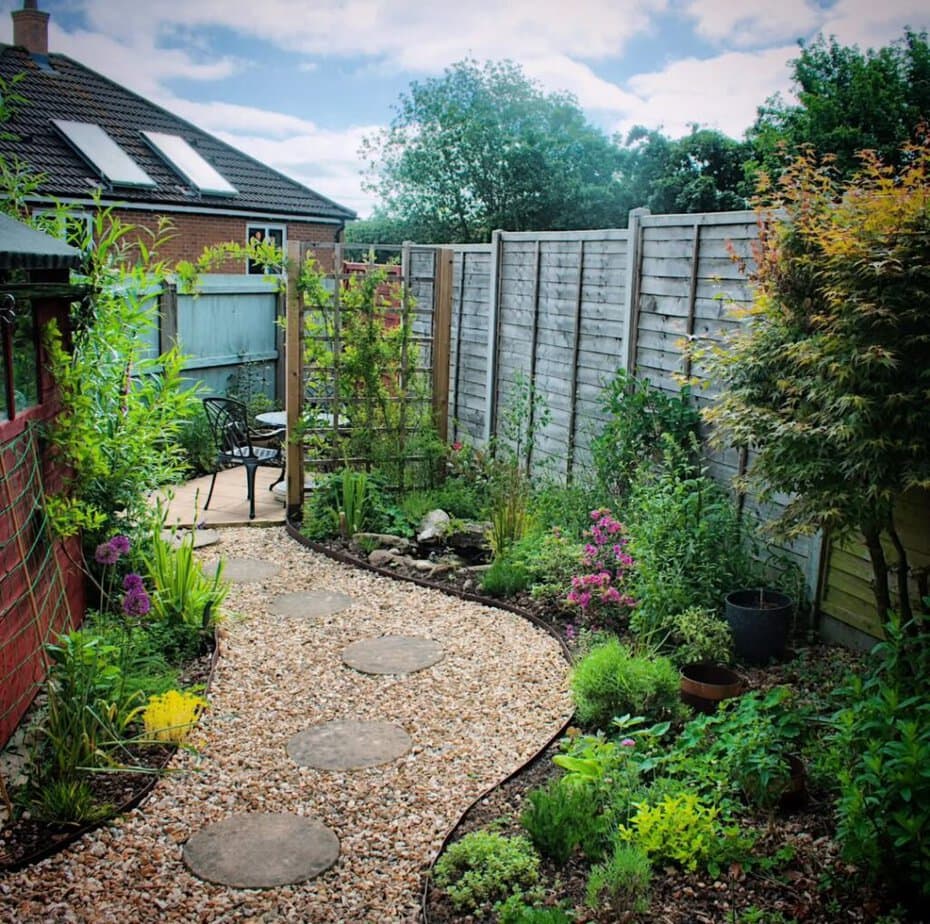
1. The Curving Gravel Path with Stepping Stones
Instead of going straight from the patio to the back fence, the path curves gently through the planting beds.
It uses oversized circular stepping stones set into golden pea gravel. This curve serves two purposes: it slows the eye, making the garden feel longer than it is, and it creates pockets of planting on either side. These pockets feel like separate little “rooms” instead of just one thin strip.
Dense, layered planting, including alliums, foxgloves, a Japanese maple, and ornamental grasses, softens the fence lines. This way, the boundaries blend into the greenery rather than standing out.
Takeaway: In a small, narrow garden, avoid a straight path from one end to the other. A gentle curve, even a subtle one, creates the illusion of length and allows for more planting along the edges.
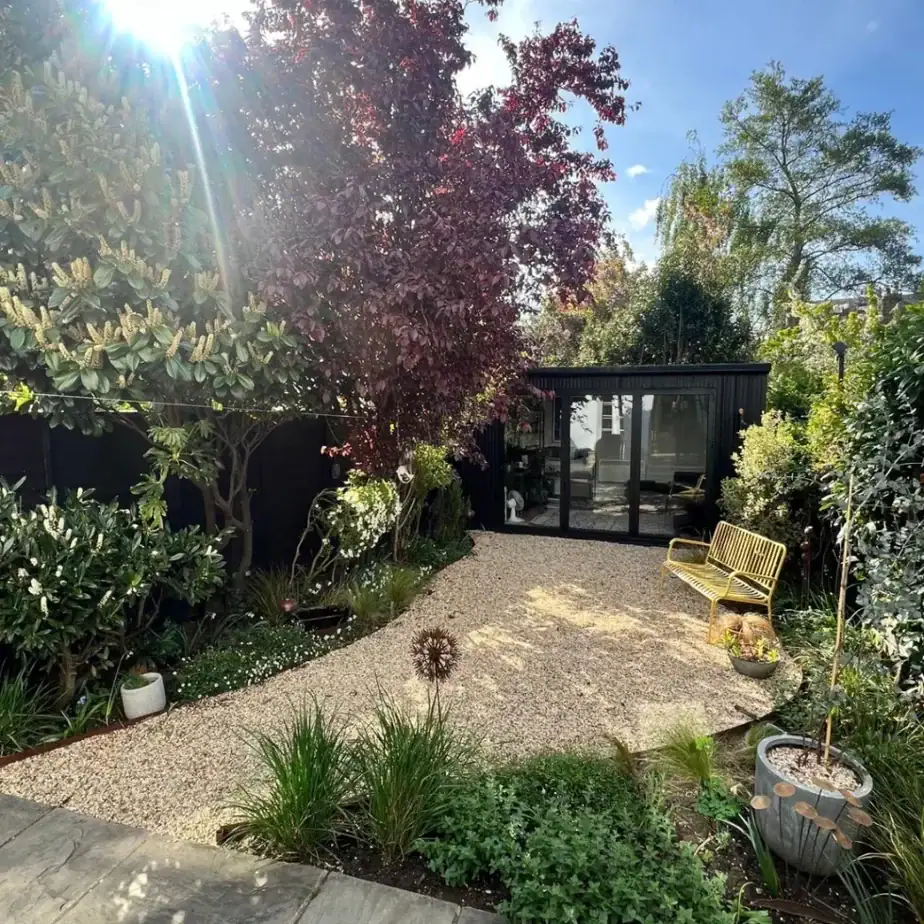
The Gravel “Room” Anchored by a Garden Studio
Here, gravel serves as more than just a path; it forms the entire floor of an outdoor room, framed by a sleek black garden studio at one end.
Painting the studio and the fence a deep charcoal black helps the structure blend into the background. This allows the eye to focus on the plants and the sunlit gravel instead. A single yellow bench adds a splash of color without making the space feel cluttered.
The loose, natural planting, which includes ornamental grasses, alliums, and flowering shrubs, spills informally over the gravel’s edge rather than being confined to a rigid border.
Takeaway: Using dark, matte paint on fences and structures helps them blend in, making a small garden feel larger and allowing the plants to stand out.
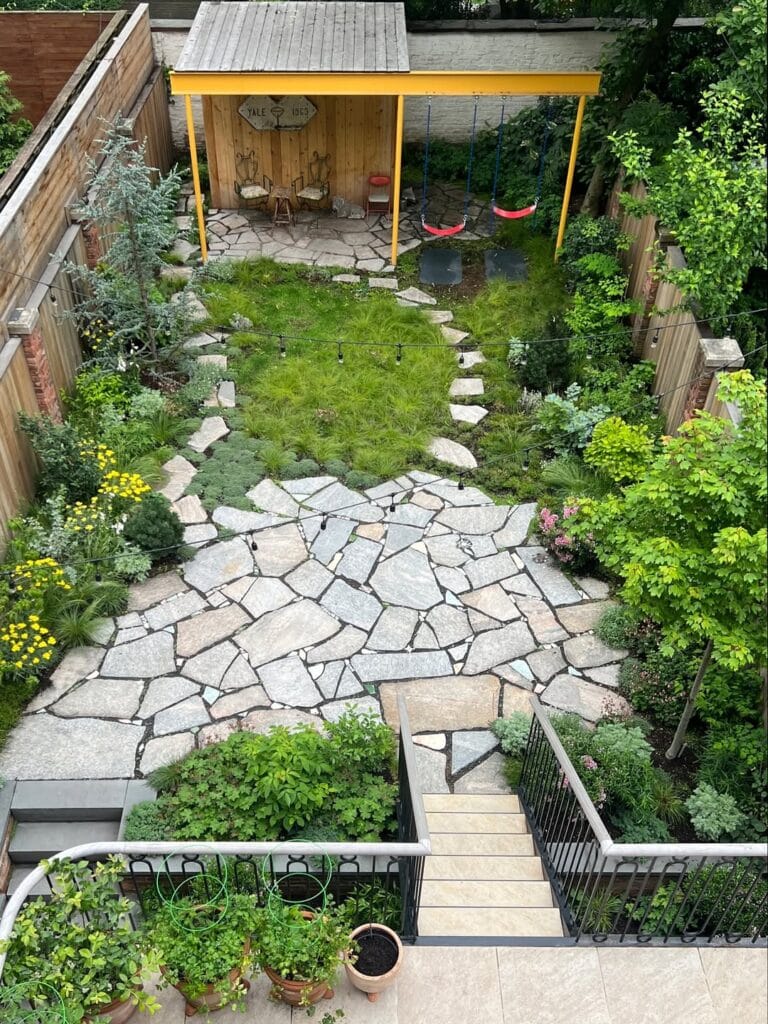
The Zoned Courtyard with a Built Pergola
This long, narrow city garden demonstrates well-executed zoning for a small space. It features a crazy-paved stone patio for dining close to the house, a strip of ornamental grass “lawn” for play in the middle, and a paved hangout zone under a bold yellow pergola at the very back, complete with swings and seating.
Instead of having one open, undefined space, the garden is divided into three distinct areas connected by stepping stones.
This design gives a long, skinny lot a sense of purpose at each stage of the walk.
Takeaway: Don’t leave a narrow garden as one continuous space. Divide it into 2-3 zones (dining, lawn, lounge) connected by a path. This approach makes the garden feel larger by creating destinations to walk to.
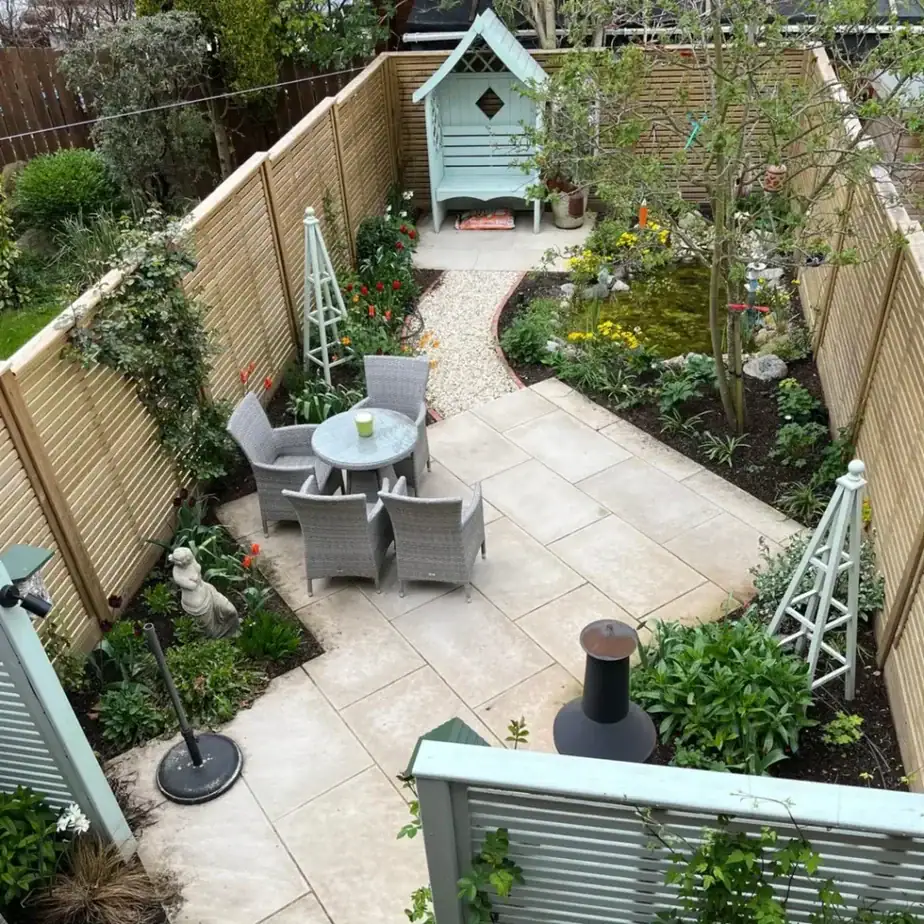
The Symmetrical Dining Garden with a Pond
This compact, fence-lined small garden uses symmetry and structure to create order in a tight rectangular area.
Matching pale-green obelisks flank the dining space, reflecting the painted arbor seat at the far end. On one side, a small wildlife pond and flowering border add softness.
The pale stone patio and light-painted woodwork keep the entire area feeling bright and open, even with tall privacy fencing on three sides.
Takeaway: When your garden is completely surrounded by fencing, use light, pale colors for hard landscaping and structures, such as paving, fences, and furniture. This will help reflect light and keep the space from feeling closed in.
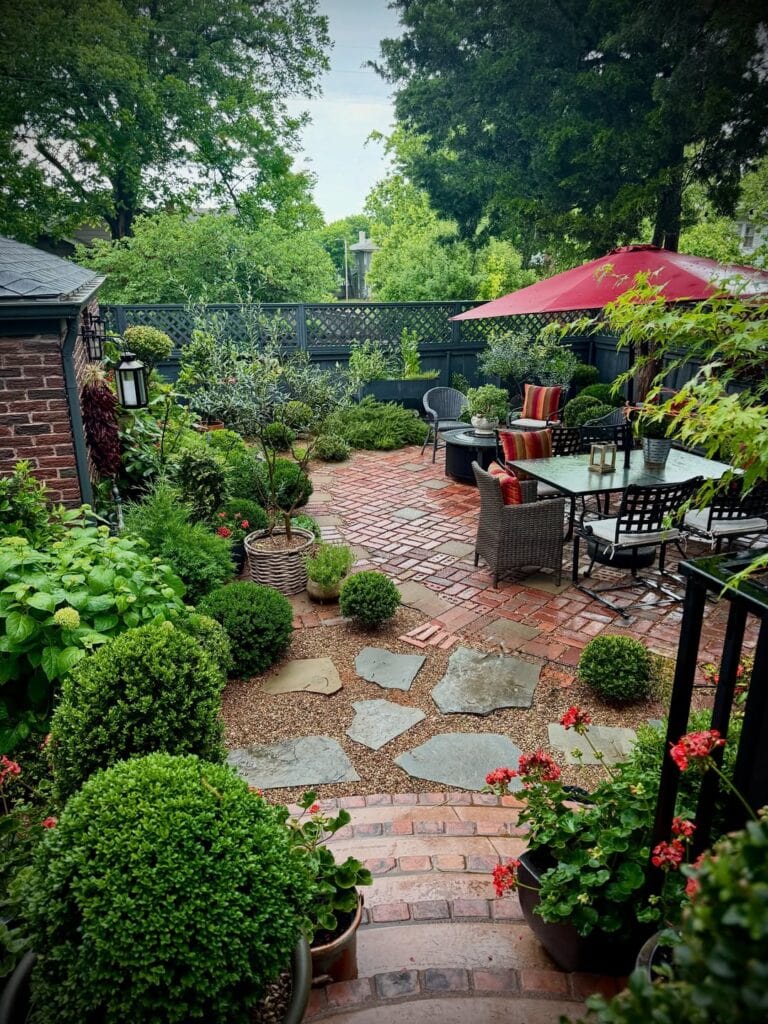
The Layered Courtyard Patio with Reclaimed Brick
This lush, intimate patio focuses on texture and layering instead of open space. Reclaimed brick arranged in a herringbone pattern transitions into loose flagstone set in gravel.
This design creates visual interest underfoot without needing any extra square footage. Clipped boxwood balls in different sizes provide structure and rhythm along the path.
A dark, lattice-topped fence and dense tree canopy overhead create an enclosed garden-room feeling, like a secret courtyard hidden behind a city house.
Takeaway: When you can’t make the area larger, create layers. Mixing two hard-landscaping materials, such as brick and stone-set gravel, adds depth and craftsmanship to a small patio in ways that a single material cannot.
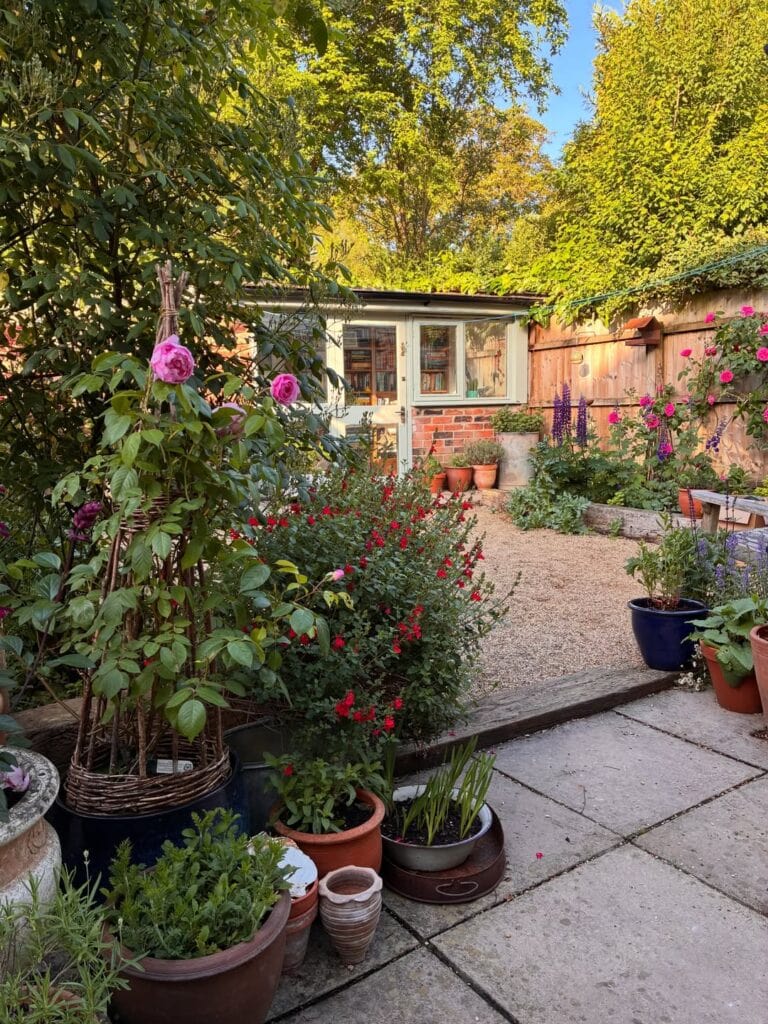
The Cottage-Style Container Garden Path
This English back garden demonstrates how to layer a small area without planting in the ground. Dozens of terracotta and glazed pots, featuring climbing roses on willow obelisks, salvias, lupins, and tulips, fill the edges of the patio so tightly that the paving almost vanishes under the foliage.
A pale-painted garden room with a brick front serves as an anchor at the far end, giving the eye a focal point, while a path of compacted gravel curves between the pots leading to it.
Takeaway: If your soil is poor, your space is small, or you simply want the flexibility to change things up, container gardening allows you to create the same lush, layered appearance as an in-ground border. You can rearrange or swap out plants from season to season.
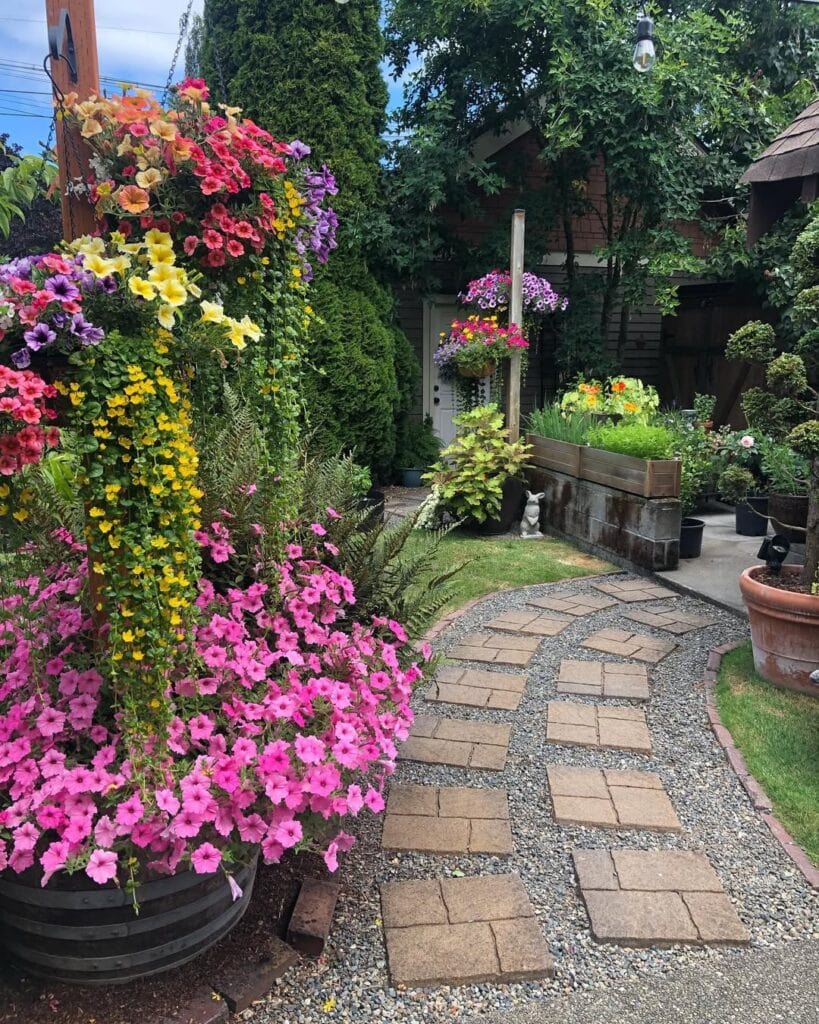
The Tiered Hanging Basket Pathway
This small garden makes its biggest visual impact at eye level and above, not just at ground level. A barrel planter filled with cascading petunias and calibrachoa forms a colorful curtain at the entrance to the path.
More hanging baskets continue the vibrant display further back near the house.
A curved path of square pavers set in gravel guides the eye through, with a raised planter box and topiary providing structure beyond the floral arrangement.
Takeaway: Hanging baskets and tall planters allow you to add large pops of color in a small space since the display goes up instead of taking away valuable ground area.
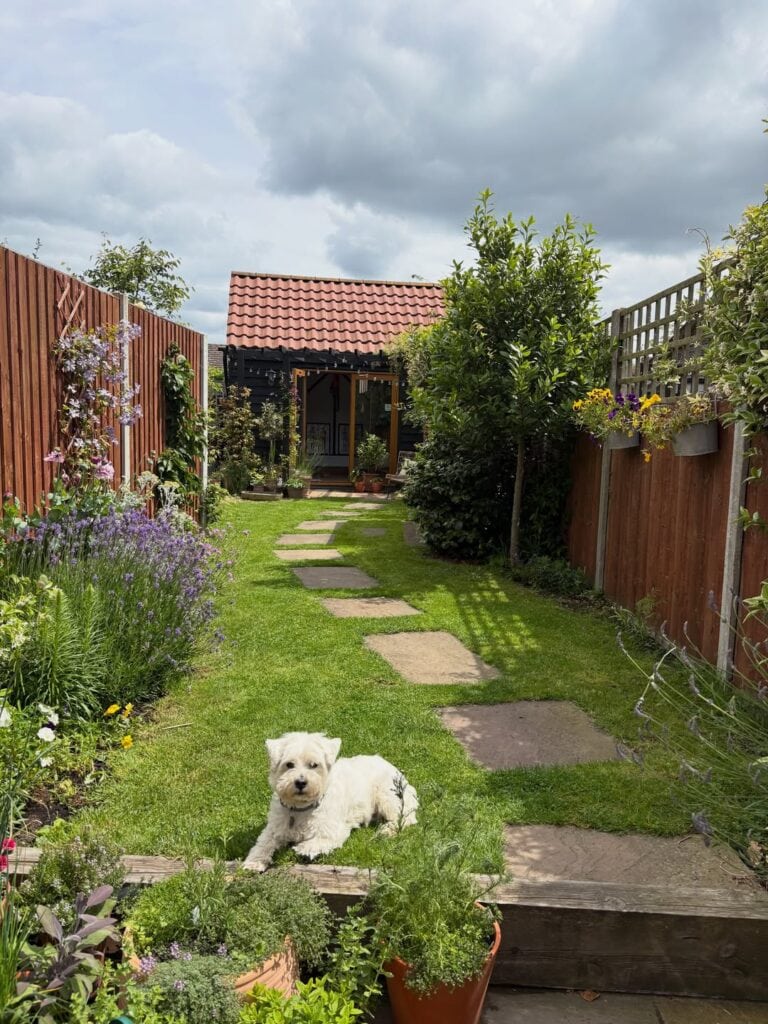
The Lawn Strip with Stepping Stones
Sometimes the simplest solution is the best one. This narrow garden features a strip of real lawn in the center. A line of square stepping stones is laid directly into the grass, creating a clear walking route to the garden room at the end.
Mixed lavender and cottage-garden borders run along both fences, softening the edges. A few well-placed trees add height without overwhelming the plot’s width.
Takeaway: You don’t always need to remove the lawn for a small garden to feel intentional. A single row of stepping stones through the grass can turn an “empty strip” into a “designed path.”
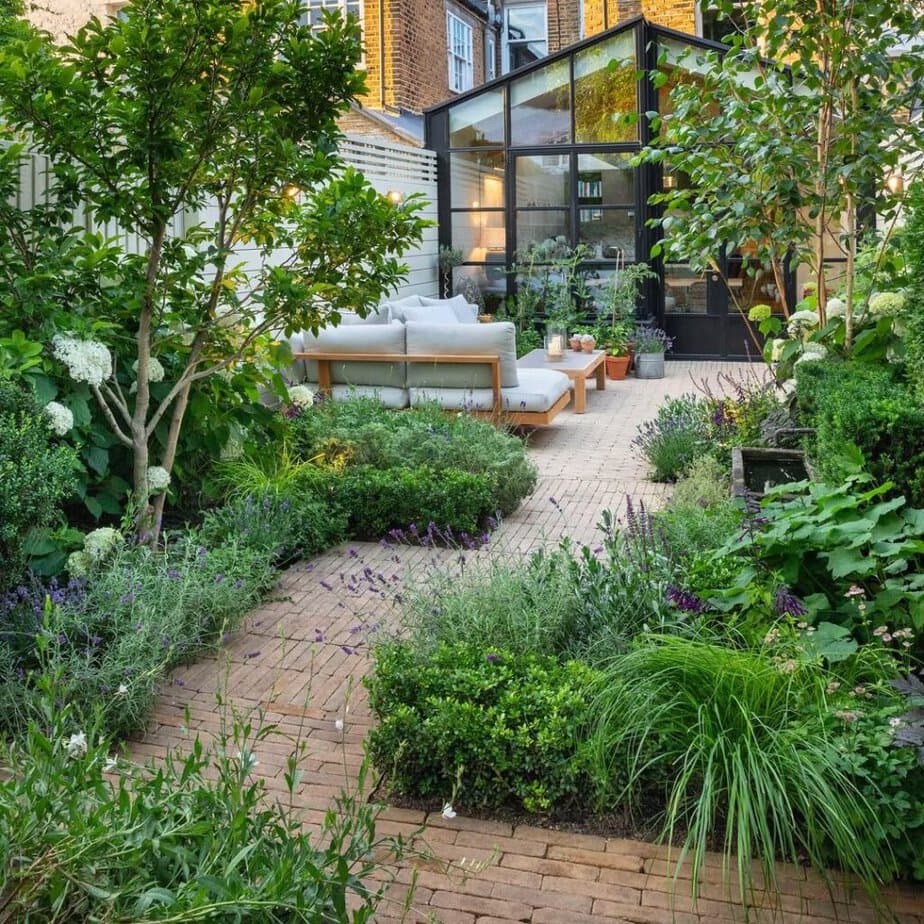
The Architectural Garden Room with a Curved Path
This stylish small garden features a glass-and-black-steel garden room as its central point. A curving brick path draws the eye toward it, winding through lush planting. Box balls and lavender soften the path’s edges.
Taller perennials and ornamental grasses arch over from both sides, creating a tunnel-like feeling even though the garden is narrow. The warm glow from inside the garden room creates a sense of a real destination at the far end, rather than just a background.
Takeaway: A well-lit structure at the end of a path, even something simple like a string of lights or an illuminated feature, gives a small garden a clear focus and makes the entire space feel thoughtfully designed.
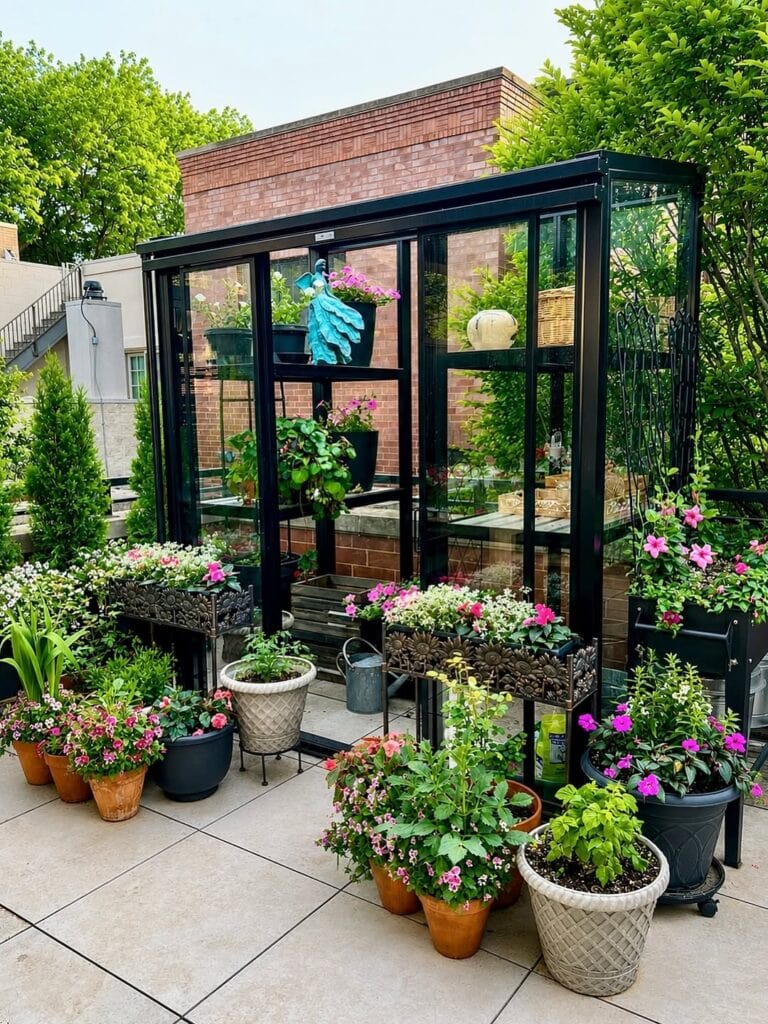
The Rooftop Greenhouse Display
This rooftop terrace shows that a “small garden” doesn’t require a yard.
Instead, it features a garden mostly made up of containers surrounding a compact glass greenhouse. Trailing vinca, impatiens, and petunias fill terracotta and decorative metal pots that are arranged at different heights.
The glasshouse serves as both a growing space and an eye-catching architectural element against the brick wall.
Takeaway: If you have a balcony, rooftop, or paved courtyard without soil access, grouping containers of different heights and materials around a strong architectural feature like a greenhouse or pergola creates a similar sense of abundance as a planted garden bed.
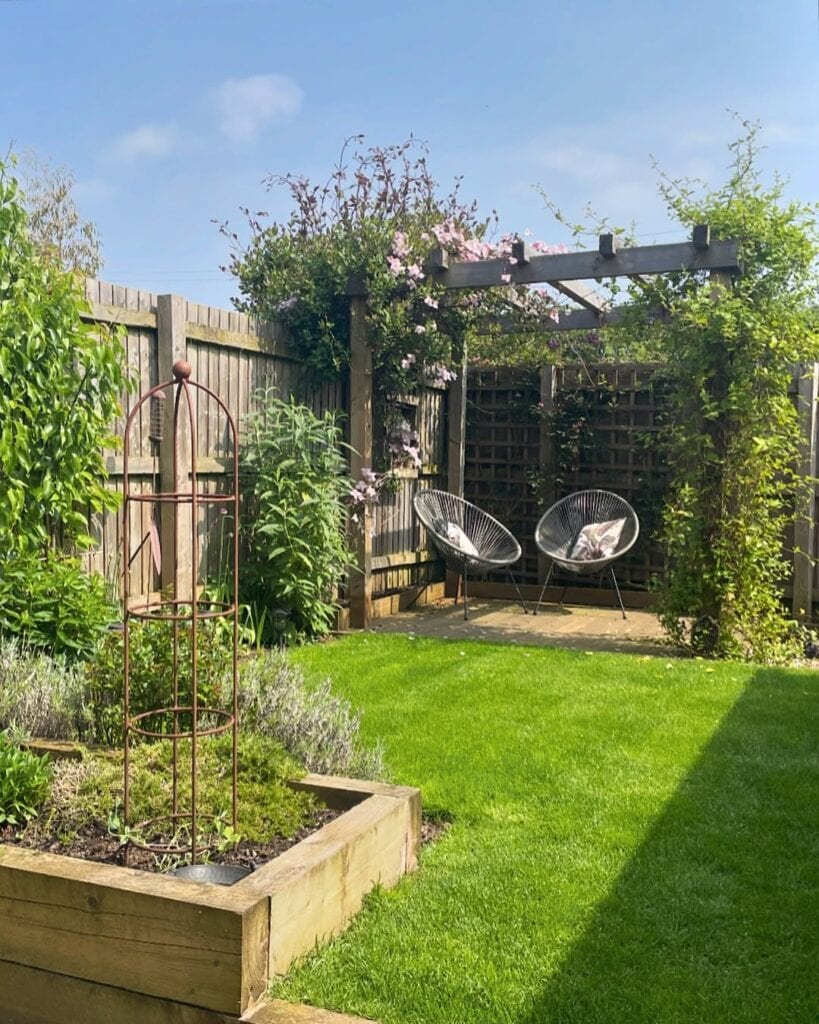
The Raised Bed Lawn with a Rose-Covered Pergola
This garden mixes open lawn with a special spot at the back: a wooden pergola filled with climbing roses and clematis. It provides shade for two woven egg chairs, which are tucked behind a lattice screen.
A large raised bed in the front keeps the plants off the lawn. This helps the grass stay clean and usable. The pergola’s lattice side panels also offer privacy without requiring a solid fence. They allow light to come through while still keeping the seating area out of view.
Takeaway: If you want to maintain a patch of real grass for kids, pets, or just for looks, place your plants in raised beds along the edges. Reserve your “destination” feature, like a pergola, arbor, or seating area, for the far end to encourage walking across the grass.
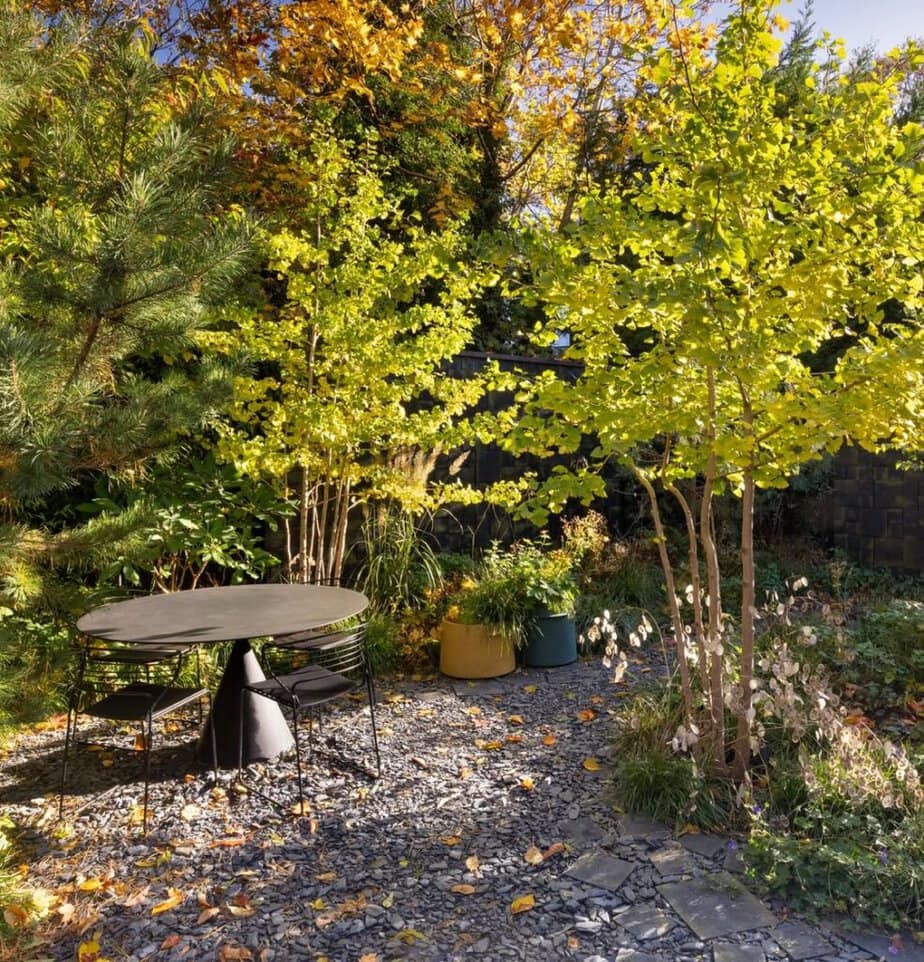
The Woodland-Style Gravel Courtyard
This shaded courtyard turns a challenging low-light area into its main feature. It has a dark, textured slate-chip floor that blends into the shadows instead of resisting them.
A simple black bistro table sits under multi-stemmed trees, whose autumn colors provide the decoration. Ornamental grasses and seed heads provide structure and movement.
Colorful planters in mustard and teal add a lively touch to what would otherwise be an all-green, all-neutral look.
Takeaway: A heavily shaded small garden doesn’t have to compete for sun-loving color. Embrace woodland planting, such as multi-stem trees, grasses, and foliage. Use one or two bold container colors to bring warmth without relying on flowers.
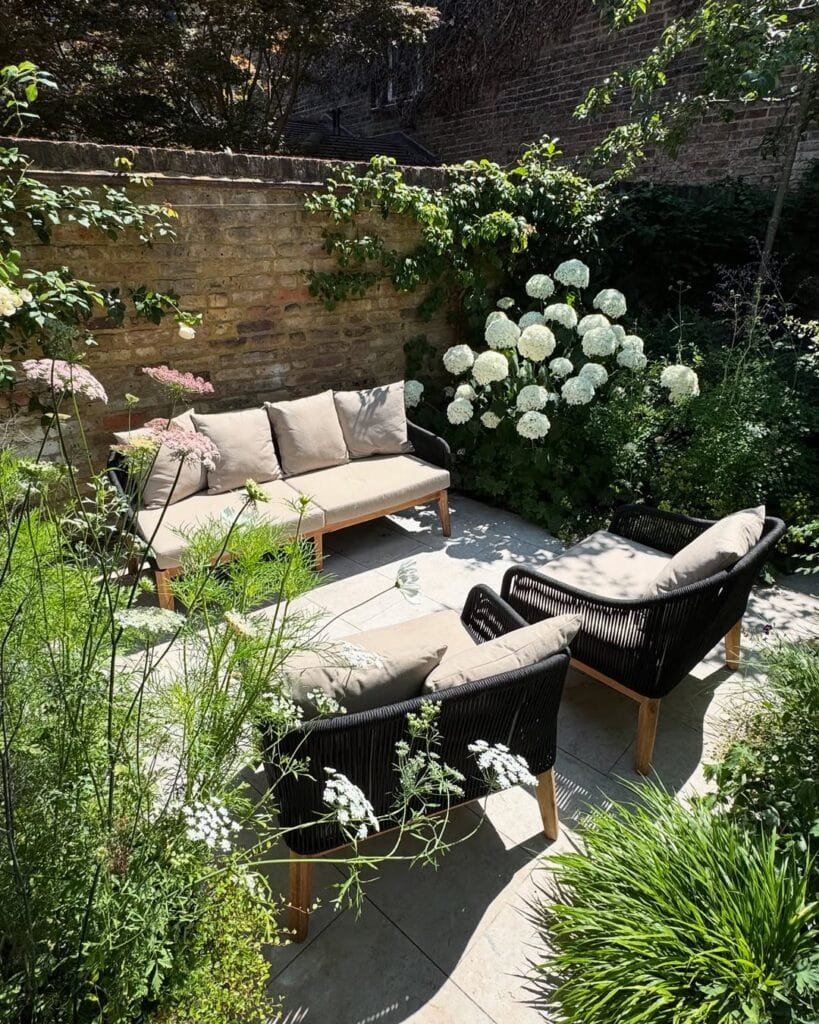
The Walled Lounge Garden
Tucked behind a reclaimed brick wall, this seating area shows that a small garden can feel like an outdoor living room instead of just a yard.
Low rope-and-teak sofas and chairs form a proper conversation set, not just a table with two chairs. Billowing cow parsley and hydrangea blooms soften the brick and stone hardscape from every angle.
The high wall, instead of feeling confining, serves as a backdrop for climbing plants. It creates a real sense of enclosure and privacy.
Takeaway: Don’t just go for a small bistro set because the space is tight. A properly scaled, low-profile sofa arrangement can fit surprisingly well in a small courtyard, making the area feel like a room rather than an afterthought.
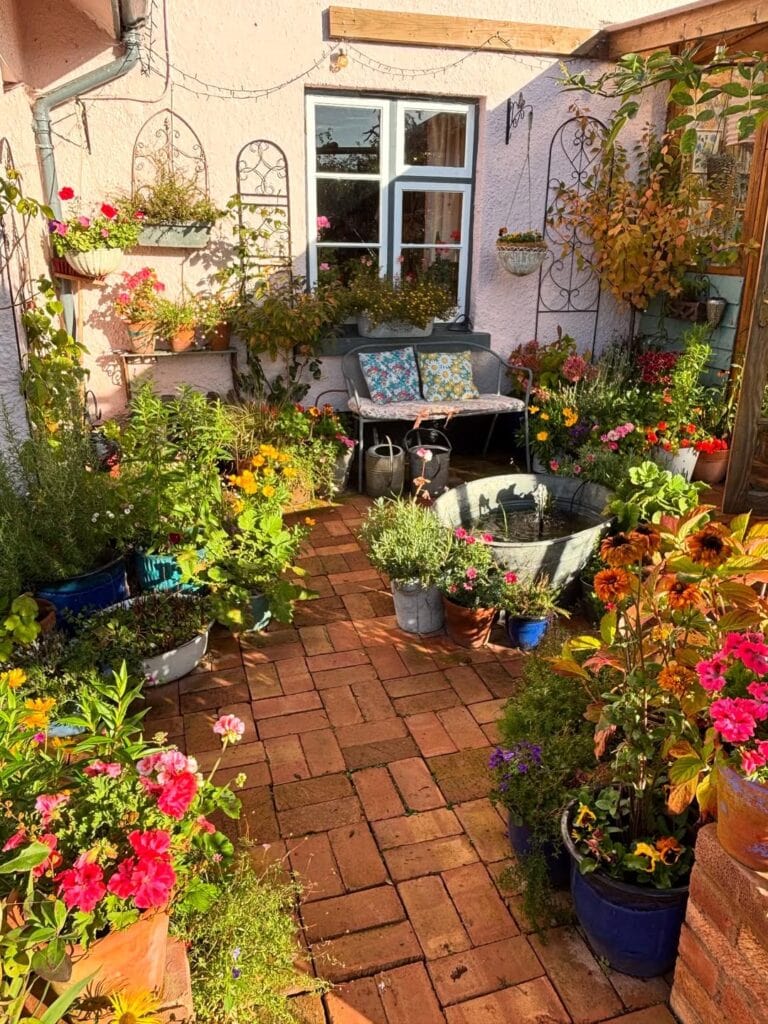
The Brick-Paved Container Courtyard
This sunny courtyard, surrounded by the house on all sides, relies mainly on container gardening. Reclaimed brick arranged in a herringbone pattern creates a warm, textured floor.
A galvanized stock tank, repurposed as a small pond, adds movement and attracts wildlife in the middle.
Vintage metal wall trellises attached directly to the house walls turn vertical surfaces into extra growing space. This shows that even a fully paved courtyard with no borders can feel like a true garden.
Takeaway: If you don’t have any planting beds, attach trellises or wall planters directly to your walls. Vertical space is free square footage that doesn’t take away from seating or pathways.
The Linear Herb-Edged Dining Terrace
This sleek, modern garden uses a strict architectural framework to organize a small rectangular plot. Large format paving is interrupted by neat strips of creeping thyme and oregano planted directly into the joints.
This turns the path into a fragrant feature. A retractable louvered pergola roof creates a defined, weather-proof dining area. Pleached trees along the boundary provide privacy at height while saving ground space.
Takeaway: Planting low-growing herbs or ground cover directly into gaps in paving adds texture, scent, and softness to hard landscaping without sacrificing usable patio space.
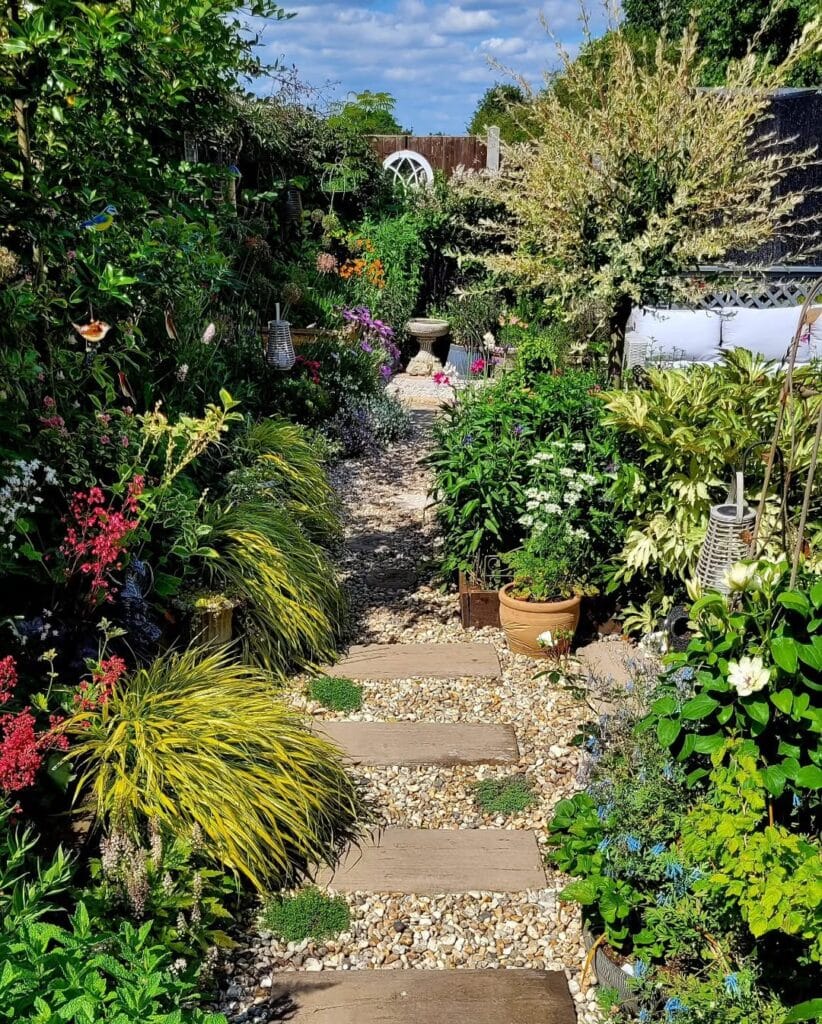
The Immersive Cottage Garden Tunnel
This small garden takes a “more is more” approach. The planting is so dense and layered on both sides that the boundaries completely disappear. The narrow gravel walkway feels like a journey through a much larger garden. Ornamental grasses, alliums, clematis, and cottage perennials spill over the path’s edge at different heights.
This creates a tunnel effect that draws you forward toward a glimpse of seating in the distance. Decorative bird ornaments and lanterns tucked into the foliage add a playful touch without needing any open display space.
Takeaway: When a path is this narrow, let the planting grow right up to the edge or even slightly over it. The feeling of being surrounded by greenery makes a small path feel like an adventure instead of a tight squeeze.