15 Small Walk-In Closet Ideas for a Space That Actually Works
A small walk-in closet can be either the most frustrating space in your home or the most satisfying. The difference usually lies in how it’s organized, not in its size.
Whether you have a narrow 4-foot-wide closet, an awkward L-shaped space, or a standard builder-grade walk-in that seems poorly designed, the right ideas can totally change how the space looks, feels, and works day to day.
In this guide, you’ll find practical small walk-in closet ideas that cover:
- Layout configurations, which setup works best for your specific shape and size.
- Storage solutions, from budget-friendly DIY hacks to custom-built-in systems.
- Lighting and visual tricks to make the space feel bigger and brighter right away.
- Style inspiration because functional doesn’t have to mean boring.
- Common mistakes to avoid so you don’t waste money on things that won’t work.
Whether you’re starting fresh or just trying to organize the chaos, this guide will help you create a small walk-in closet that truly meets your needs.
15 Small Walk-In Closet Ideas
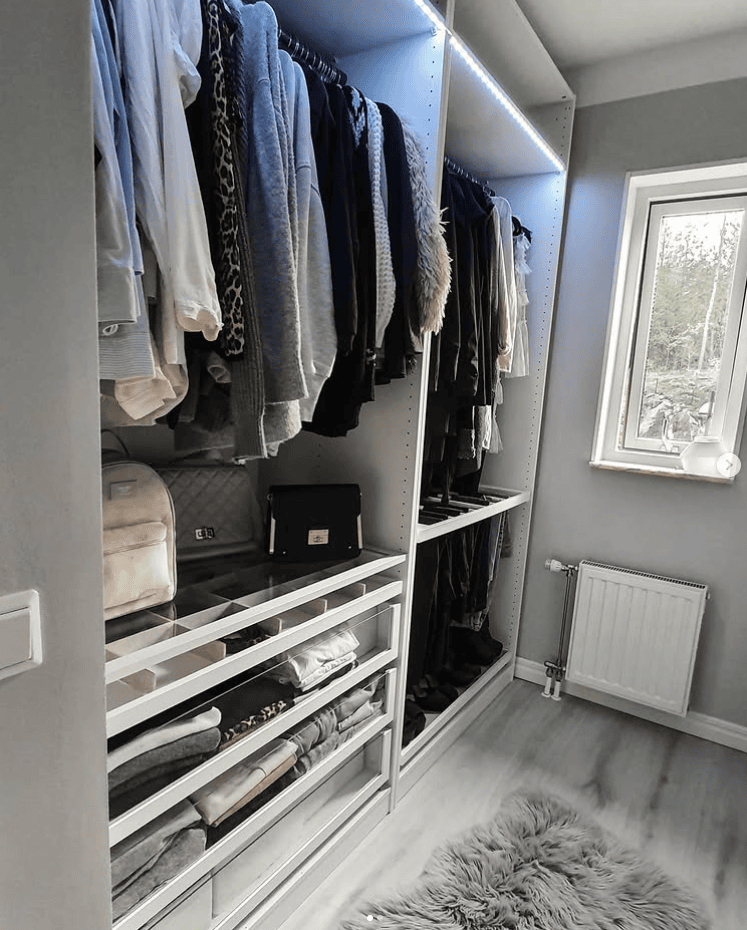
1. The Single-Wall Layout (Best for: very narrow or corridor-style closets)
If your walk-in is more of a “walk-through,” long and narrow, typically 3 to 5 feet wide, the single-wall layout is a great choice. Instead of trying to pack storage on both sides and creating a cramped space that’s hard to move in, you put everything on one wall and leave the opposite side clear.
How it works:
- One full wall has a mix of hanging rods, shelves, and drawers.
- The opposite wall stays open or is used only for a mirror and hooks.
- The floor space in front remains clear, making the closet feel more spacious than it is.
What to prioritize on your single wall: Double hang rods in one section for shirts, jackets, and folded pants. A tall shelving unit in the center or corner for shoes, folded items, and accessories. Overhead shelves that run the full length of the wall for bins and seasonal items.
The biggest mistake with this layout is making it too shallow. Your hanging rod needs at least 24 inches of depth to hang clothes without them pressing against the back wall. Don’t give that up for extra floor space. Ideal closet dimensions: 3 to 5 ft wide, 6 to 10 ft long.
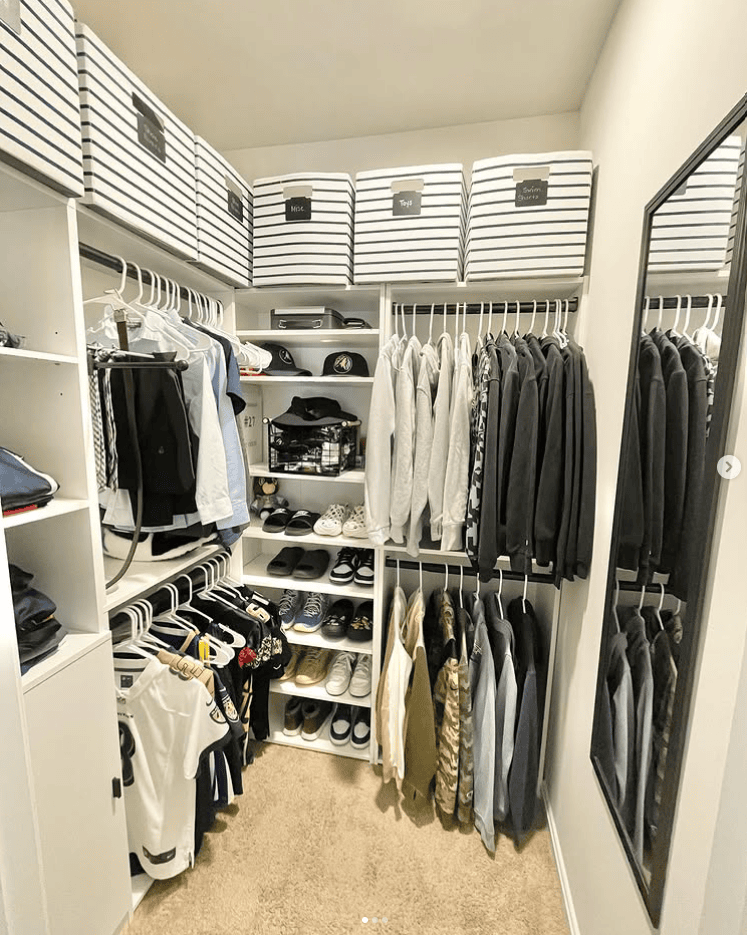
2. The L-Shaped Layout { Best for: corner closets or square-ish spaces with an offset entry}
The L-shaped layout uses two adjacent walls for storage, leaving the third wall, typically the one with the door, open. This setup is one of the most flexible options for small walk-in closets because it separates two functions. One wall is for hanging, while the other is for shelving and folded storage.
How it works:
- The longer wall handles most of your hanging needs. You can hang long items on one end and double-hang on the other.
- The shorter adjacent wall serves as your shelving and shoe storage area.
- The entry wall remains clear or is used minimally for a mirror, hooks, or a small bench.
Why it works so well in small spaces: The L-shape creates a natural visual break, making the closet feel designed rather than cramped. It also allows you to see nearly everything from the center of the room.
Pro tip: Place your most-used items on the longer wall. Put your shoes or accessories on the shorter wall. This way, your daily routine flows seamlessly: grab your outfit, grab your shoes, and go.
Ideal closet dimensions: 5×6 ft, 5×7 ft, or any space with one wall noticeably longer than the other.
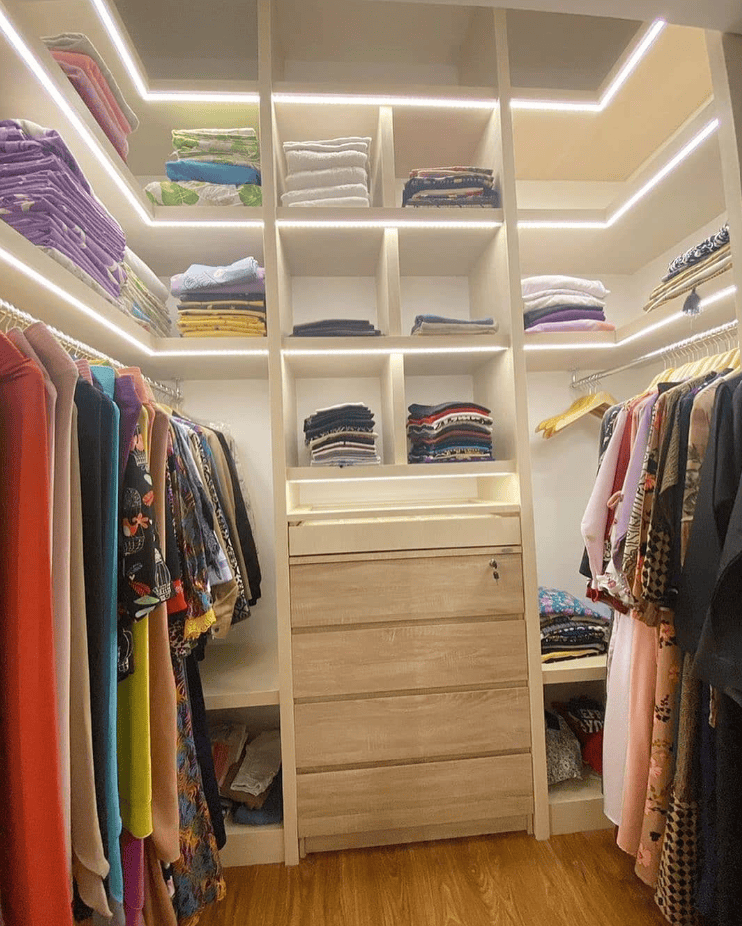
3. The U-Shaped Layout { Best for: square walk-ins and the gold standard for small closet efficiency }
If your closet is relatively square and has enough width to walk comfortably down the center, with at least 36 inches of clear floor space, the U-shaped layout is the most efficient setup available. It uses three walls, left, right, and back, turning every inch of wall space into functional storage while keeping the center open for movement.
How it works:
- Left and right walls typically handle hanging. You can make them the same or different, for example, one side for his and one for hers, or one for tops and one for bottoms and dresses.
- The back wall becomes the feature wall, which is great for shelving, a shoe display, a built-in dresser tower, or a combination of all three.
- The center floor space remains completely clear.
Why it’s the gold standard: In a U-shaped layout, you can stand in one spot and see your entire wardrobe. Nothing is hidden or buried, and getting dressed in the morning becomes easy.
What to watch for: The U-shape only works if you have enough width. If the two side walls are too close together, you’ll create a cramped tunnel effect. The minimum comfortable clearance between opposing hanging rods is 52 inches, which includes 24 inches of depth on each side plus at least 4 inches of space between hanging garments.
Ideal closet dimensions: 5×7 ft, 6×6 ft, 6×8 ft.
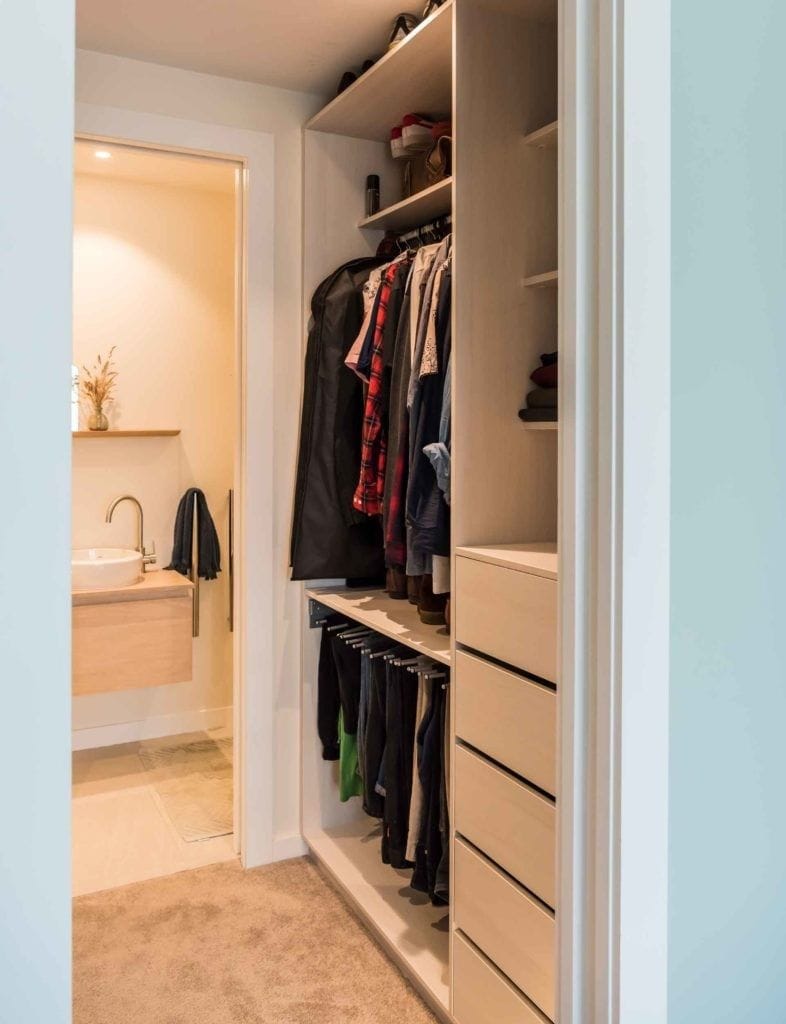
4. The Pass-Through Layout { Best for: closets that connect a bedroom to a bathroom or hallway }
The pass-through closet is a unique situation. You have storage on both sides, but you must keep a clear path down the middle for foot traffic. While it may seem limiting, it offers a great chance for effective design when done right.
How it works:
- Both long walls are lined with storage, typically a mix of hanging and shelving.
- The path down the center stays completely clear, with a minimum of 36 inches.
- Since both walls are visible at the same time, consistency in style and color is especially important.
The design challenge and opportunity: Pass-through closets are basically a live showcase of your wardrobe. This means organization and looks matter more here than in any other layout. Using uniform hangers, keeping bin colors consistent, and color-coding clothes can make a big difference. When done well, it resembles a high-end retail display. When done poorly, it feels chaotic.
Smart storage tips for pass-throughs:
- Use the entry end (bedroom side) for the most frequently accessed items.
- Reserve the exit end (bathroom side) for shoes, accessories, and items used as part of a getting-ready routine.
- Take advantage of ceiling height. Overhead storage bins along both walls can hold a lot without taking away from your floor space.
Ideal closet dimensions: Any length, minimum 6 ft wide (to allow 36 in. clearance plus 15–24 in. depth on each side).
5. The LED-Lit U-Shape That Steals the Show
This small U-shaped walk-in clearly shows that lighting is the most important upgrade you can make to a closet. LED strip lights line the ceiling and run under every shelf, giving off a warm, even glow that makes the space feel like a high-end boutique rather than just a regular closet.
The layout is well-balanced. Both side walls are used for hanging clothes, with a colorful wardrobe arranged like a rainbow on the left and assorted garments on the right. The back wall has a floor-to-ceiling grid of open shelving, filled with neatly stacked folded items in every cube. At the bottom, a warm wood drawer unit adds natural texture and breaks up the all-white cabinetry. The warm hardwood floor ties everything together.
The main point is clear: the right lighting doesn’t just light up your closet, it changes how the space feels.
Best for readers who are unsure about LED strip lighting and want to see the before-and-after effect in one image. This one will convince them instantly.
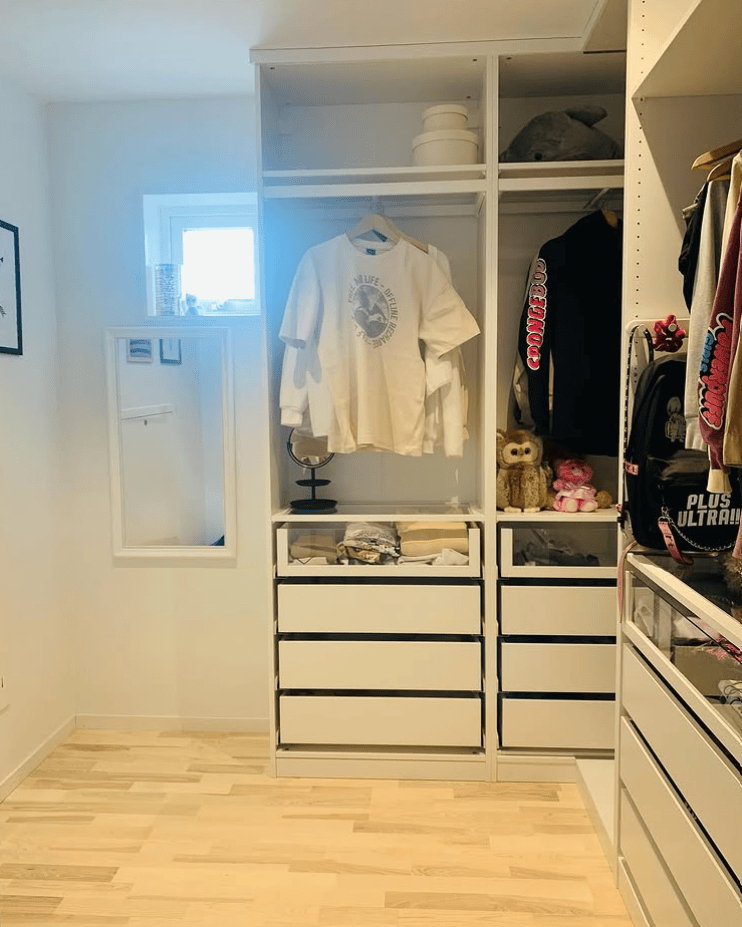
6. The IKEA PAX Build That Proves You Don’t Need a Custom Budget
Clean, bright, and functional, this walk-in is a testament to the IKEA PAX system and the possibilities of thoughtful planning.
The main wall features two full-height PAX units side by side. They offer open hanging space at the top and a generous set of deep drawers below. This is one of the most practical layouts for a mixed wardrobe. A small window between the units brings in natural light.
This, along with the pale blonde wood flooring and all-white cabinetry, makes the space feel airy and open, despite its modest size. The right-hand wall adds a secondary shelving and hanging section. This keeps the layout flexible and the storage continuous. A small framed print on the wall serves as a reminder that even a functional closet can have a personal touch.
This closet shows that a well-planned flat-pack system, installed carefully, can match the look and function of a custom build at a much lower cost.
Best for: budget-conscious readers, renters who own their space, or anyone looking into the IKEA PAX as a closet solution.
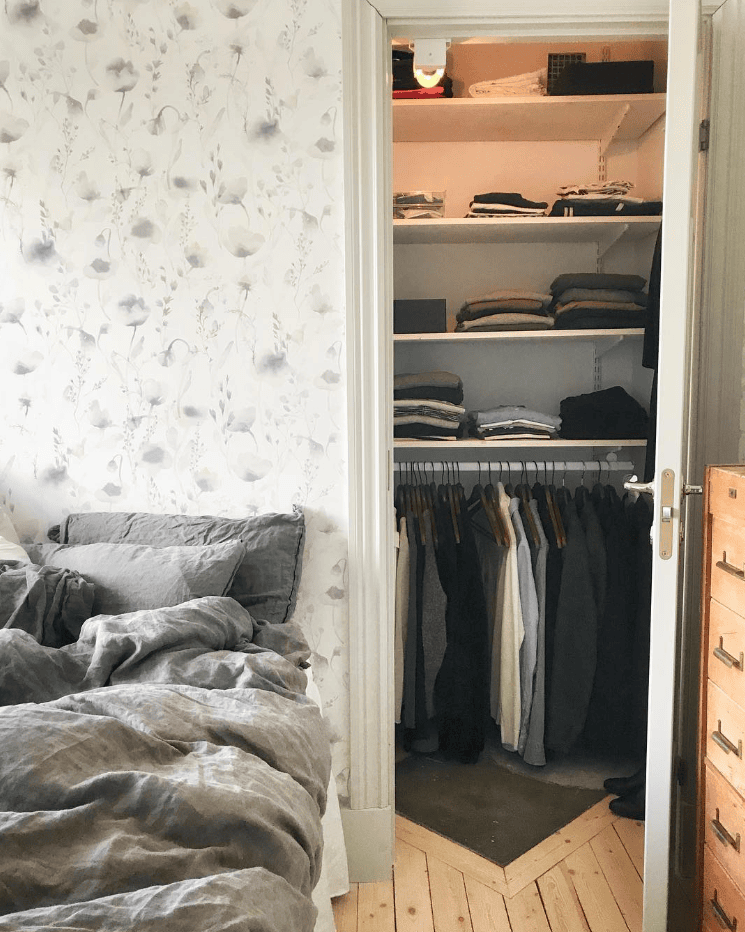
7. The Minimalist’s Small Closet Done Perfectly
Sometimes the most inspiring closet isn’t the biggest or most elaborate; it’s the one that shows you how much you can achieve with very little. This tiny walk-in is a lesson in minimalist organization.
Simple white adjustable shelves span the back wall across three tiers, holding neatly folded neutrals and basics in calm, orderly stacks. Below the shelves, a single hanging rod displays a curated row of garments on matching dark wood hangers, grouped by color in cool greys and blues, with nothing unnecessary taking up space.
The warm pine floorboards extend from the bedroom, making the closet feel like a natural part of the room instead of a separate storage area. There’s no drama here, no statement lighting, no custom cabinetry; just careful editing and thoughtful organization.
This closet reminds us that a capsule wardrobe and a commitment to keeping only what you love will always be better than a bigger closet full of things you don’t.
Best for: minimalist readers, small space dwellers, or anyone who needs permission to simplify rather than add more storage.
8. The Moody Single-Wall With LED Drama
This single-wall closet is bold, and it definitely works. Built around a PAX-style system in white, the contrast between the crisp white cabinetry and the cool grey walls creates a striking look that feels more designed than most walk-ins that are twice its size.
The upper section focuses entirely on hanging items, with a full rod holding an organized mix of outerwear, knitwear, and everyday pieces. Below the hanging area, a shelf displays structured handbags and clutches like accessories in a store.
Glass-front drawers at the base keep folded items visible and easy to reach without messing up the clean aesthetic. A small window on the right wall lets in natural light, softening the dark palette.
This closet shows that a dramatic color scheme, when paired with white storage units, LED lighting, and natural light, can make a small walk-in feel cozy and luxurious instead of cramped.
Best for: readers who love moody, design-focused interiors and want to see that dark walls can fit beautifully in a small closet.
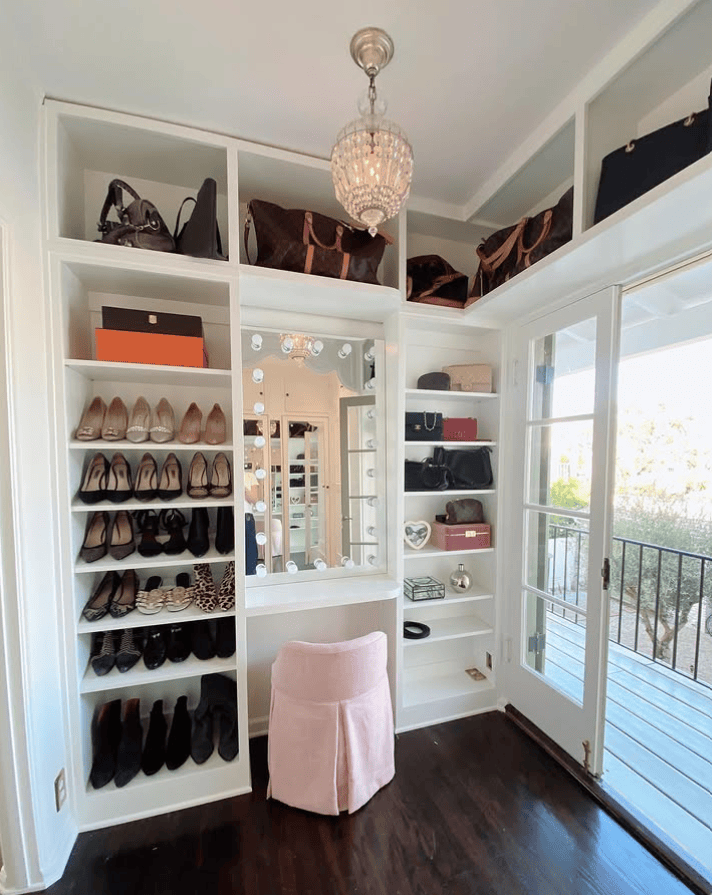
9. The Glamour Closet With a Vanity at Its Heart
This closet changes what a small walk-in can be. Every design choice supports one goal: a personal dressing room that feels like it belongs in a luxury hotel suite.
The highlight is a Hollywood-style vanity mirror with globe bulb lighting. On the left, a full wall of open flat shoe shelving displays heels, flats, and mules in neatly arranged rows, similar to a boutique. To the right, open cubbies hold handbags, jewelry boxes, and neatly organized accessories.
Above everything, a continuous upper shelf runs around the room. It keeps oversized totes and travel bags easy to reach but out of sight. The standout feature is a beaded crystal chandelier hanging from the ceiling. It casts warm, flattering light across the space, making every morning feel special. A pink upholstered vanity stool adds the finishing touch.
This closet shows that you don’t need a separate room for a vanity. You just need a vision, a well-placed mirror, and the confidence to treat your getting-ready routine as a daily ritual.
Best for: readers who love glamour and want their closet to feel like a destination, not just a storage space. High potential for Pinterest saves; consider this your standout image.
10. The Family-Friendly L-Shape That Actually Works
Built in a compact L-shaped layout with a white modular shelving system, this walk-in serves as shared storage that works hard for a busy household.
The upper shelf is lined from end to end with matching navy-striped fabric bins, each clearly labeled so nothing gets lost and nothing is dumped randomly.
Below that, the space is organized with care. A center shelving tower holds shoes and caps, double hang rods are on either side for tops and shorts, and a slim full-length mirror on the right wall adds depth and function without taking up any floor space.
The color scheme crisp white, warm beige carpet, navy bin accents keeps the whole area feeling calm and unified, despite the number of items stored.
The lesson this closet teaches is one of the most valuable in organization: matching containers and clear labels will make any space feel more controlled, no matter how much you’re storing.
Best for: readers with families, shared closets, or anyone managing many categories. Also ideal for anyone looking into labeled bin systems.
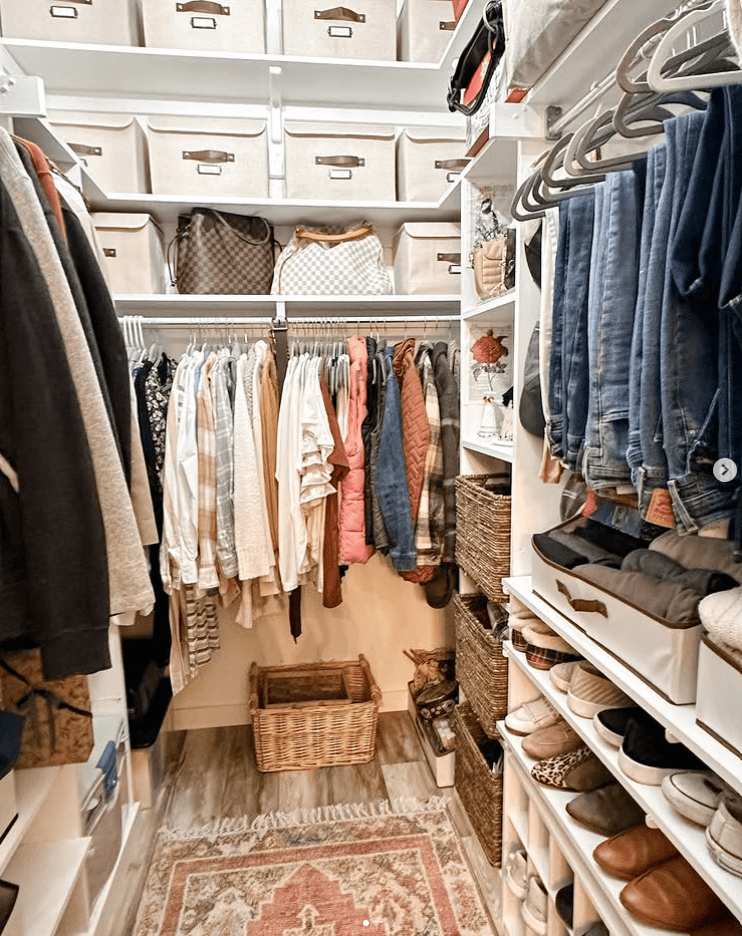
11. The Warm & Lived-In Walk-In That Feels Like Home
This small walk-in features a warm, organic look that feels genuinely personal instead of staged. The shelving is white and practical, but its styling choices make it unique: linen storage boxes with leather tab pulls line the upper shelf, woven rattan baskets sit on the mid-shelves for folded items, and a small vintage-style runner rug on the floor adds warmth and texture.
A rattan basket on the floor collects shoes casually instead of storing every single pair on shelves. Designer handbags are displayed openly on a dedicated shelf, and jeans are hung vertically on the right wall rather than folded, keeping them crease-free and easy to see. The overall effect is a closet that feels curated yet relaxed, organized yet lived-in.
This space shows that warmth and personality don’t need to be sacrificed for function. The right textures, a vintage rug, and natural materials can make even a storage area feel like a room you love.
Best for: readers drawn to warm, cottagecore, or organic modern interiors who want their closet to feel cozy rather than clinical.
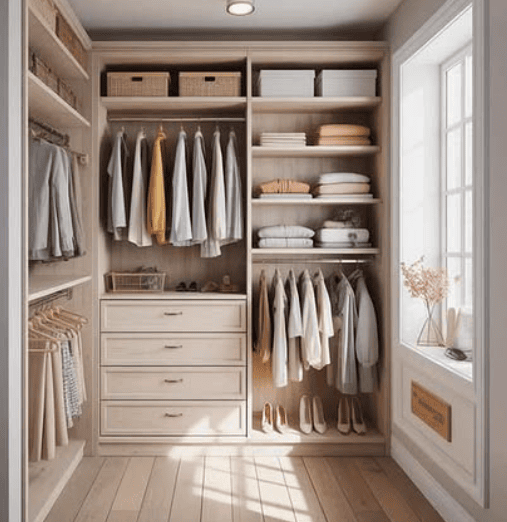
12. The Sun-Drenched L-Shape That Nails the Basics Beautifully
Sometimes the most helpful closet is the one that works well without being flashy. This light-filled L-shaped walk-in is just that. It gets plenty of natural light from a large window and features warm blonde wood throughout. Every element here does its job simply and quietly.
The back wall handles most of the storage. It has open shelving for neatly folded items, woven bins at the top, a single hanging rod for shorter garments, and a well-sized three-drawer unit below for folded essentials. Shoes are placed on the floor under the lower hanging section. There’s no need for a complicated shelving system at this scale.
The left wall includes a second hanging rod for longer items, keeping the two areas visually and functionally separate. A small vase of dried flowers on the windowsill and the warm wood tones make this space feel less like a storage room and more like a carefully designed part of the home.
This closet serves as an ideal example for anyone starting from scratch. It shows the essential building blocks of a functional walk-in without overwhelming you with too many options.
Best for: readers who feel intimidated by complex systems and want to see a simple, achievable starting point done well. Great for first-time homeowners or anyone setting up their first proper closet.
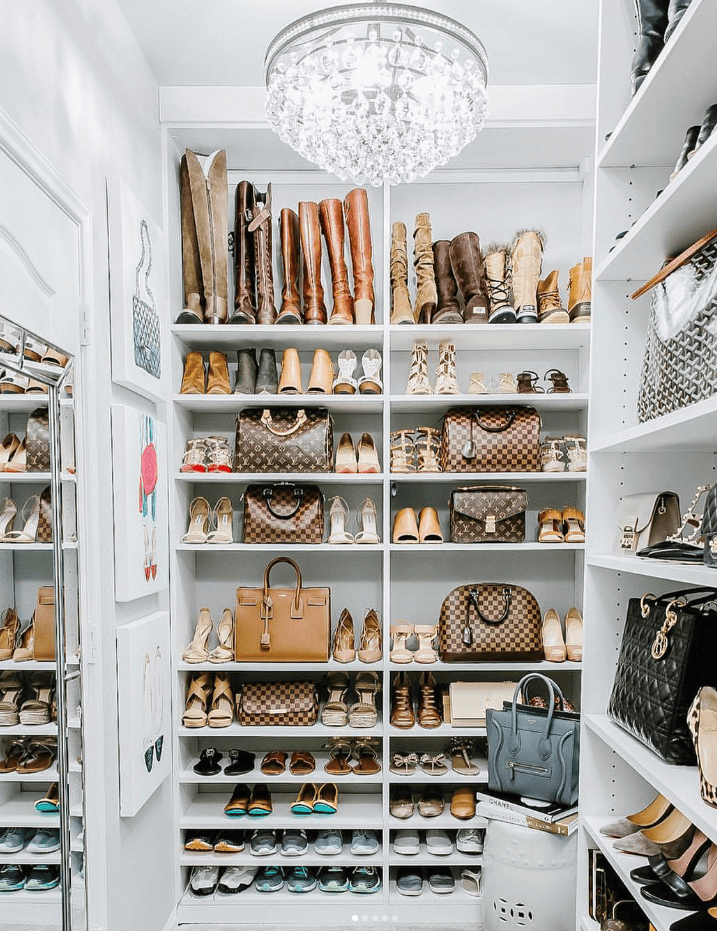
13. The Shoe and Bag Collector’s Dream Wall
Let’s be clear about what this closet is: it is not trying to be modest. It is a dedicated space for an extraordinary shoe and handbag collection, and it shows total confidence.
Floor-to-ceiling open shelving fills the entire back wall. The shelf heights are set to fit everything from knee-high riding boots standing tall at the top to flat sandals arranged in neat rows at the bottom.
Structured designer handbags are woven into the shelving between the shoes, displayed on their own shelves as the statement pieces they are. A full-length mirror on the left wall creates a sense of depth and reflects light beautifully across the collection. Two small framed pieces of fashion art add a personal, stylish touch. Hanging above everything is a crystal chandelier that catches the light and scatters it across each surface.
The organizational idea here is surprisingly simple: when you have a large collection of beautiful items, open shelving and consistent spacing do more for design than any cabinet system ever could. Display it. Own it.
Best for: the reader with a serious shoe or bag collection who needs to see that a small closet can fit and beautifully showcase a large number of accessories.
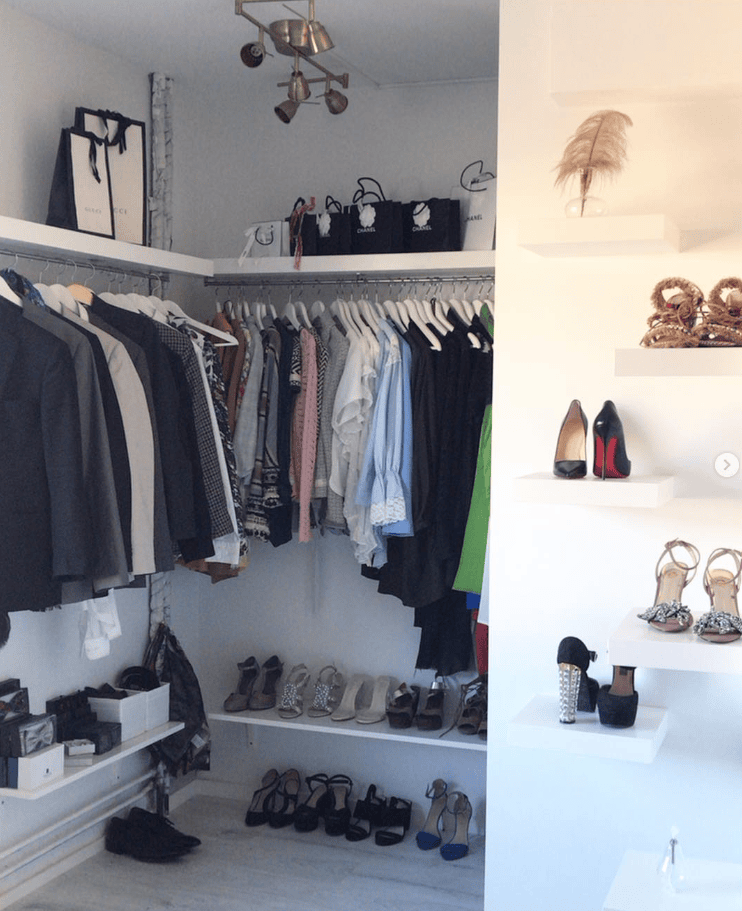
14. The Fashion Editor’s Closet: Minimal Storage, Maximum Style
This closet feels like the space of someone who knows what they own, loves each piece, and has no tolerance for clutter. It’s small and carefully minimal, yet brimming with personality.
The main hanging wall features a single rod no double hang or fancy shelving just one clean rod filled with a thoughtfully arranged wardrobe by color. On the left are dark tailored pieces, while whites and brights flow to the right.
Shoes casually line the lower shelves, with a few pairs displayed on the floor below. The true design highlight is on the opposite wall: a series of floating shelves, each showcasing one or two pairs of standout heels a pair of red-soled black pumps, strappy sandals, and embellished mules set up like art in a gallery.
A brass multi-arm ceiling light fixture adds an industrial-chic vibe, grounding the entire look in a confident style. Designer shopping bags line the upper perimeter shelf, providing a polished touch that feels fashion-forward instead of messy.
This closet demonstrates that less can be luxurious. When every item is something you cherish, you don’t need more space; you need better editing.
Best for: fashion-forward readers, capsule wardrobe fans, or anyone who prefers to treat their closet like a curated personal gallery rather than just a storage area.