15 Small Courtyard Gardens That Prove Size Was Never the Problem
If you have a courtyard, you might feel some pressure about it. It’s not a “real” garden; it’s simply a space between walls, a paved area the architect overlooked, or a shady spot that gets barely forty minutes of sun on a good day.
You might have tried a few potted plants that leaned toward the tiny bit of light and stopped growing by July. Perhaps you’ve concluded that the space is just not useful: too small, too enclosed, too shaded to ever look intentional.
A courtyard isn’t a garden with limitations. It’s a garden with a specific shape. Four walls (or three, or a wall and a fence) mean you control every view, every reflection, and every inch of vertical space. You can manage the microclimate instead of battling against wind, sprawl, or a neighbor’s view. The “problem” of being enclosed is actually the reason courtyards in places like Marrakech, Kyoto, and Seville have been some of the most beautifully designed outdoor spaces for centuries.
Being small and contained isn’t a less desirable option compared to a large garden; it’s an entirely different design challenge, and one that might be easier to tackle.
Let’s dive in.
15 Small Courtyard Garden Ideas
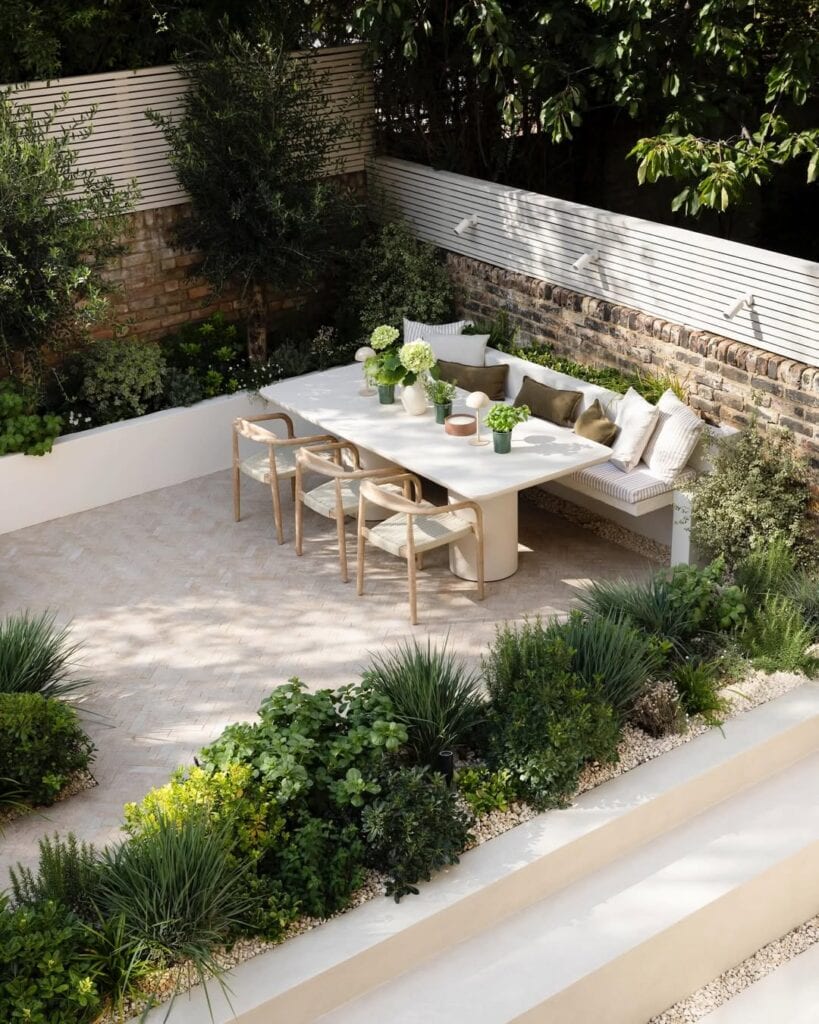
The Built-In Bench That Eats the Boring Corner
This courtyard addresses the common “L-shaped dead zone” issue by placing an upholstered bench seat directly along both walls. This avoids the need for freestanding furniture in the middle of the space.
The white-rendered base and the exposed brick above it are intentionally left raw and unfinished. The variety in texture, including smooth render, rough brick, woven chairs, and linen cushions, provides the decoration. This allows the layout to remain simple and symmetrical.
Pairing the corner bench with a single round table and lightweight chairs keeps the rest of the paved floor open. This is the only way a small courtyard can comfortably seat six people without feeling cluttered.
Takeaway: If your courtyard has an odd corner or a blank wall, build seating into it instead of around it. A fitted bench saves floor space that a sofa or separate chairs would take up.
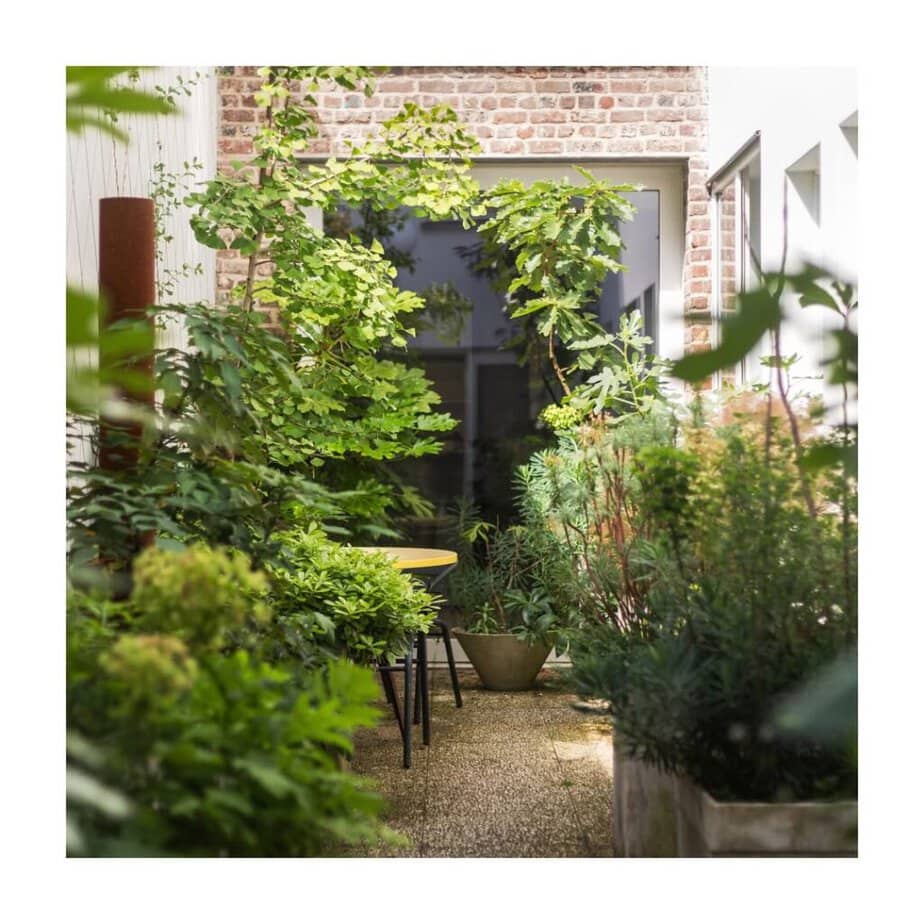
The Framed View, Not the Open View
Instead of trying to make this narrow side passage seem larger, the design fully embraces a “tunnel” look.
Tall, loose plants on both sides draw your eye toward a small bistro table at the far end, with the brick wall and window providing a backdrop. This approach works because a narrow space, when seen straight on, feels like a corridor leading to a destination rather than a cramped gap.
The destination, like a chair or a pop of yellow, gives your eye a place to rest instead of making it move around aimlessly. The rusted steel column on the left also plays a subtle role; it adds a vertical touch that breaks up what would otherwise be a flat wall of green.
Takeaway: In a narrow courtyard or side yard, place a small focal point like a chair, a pot, or a piece of art at the far end, and let the plants on either side create a frame. This changes “skinny” into “intentional.”
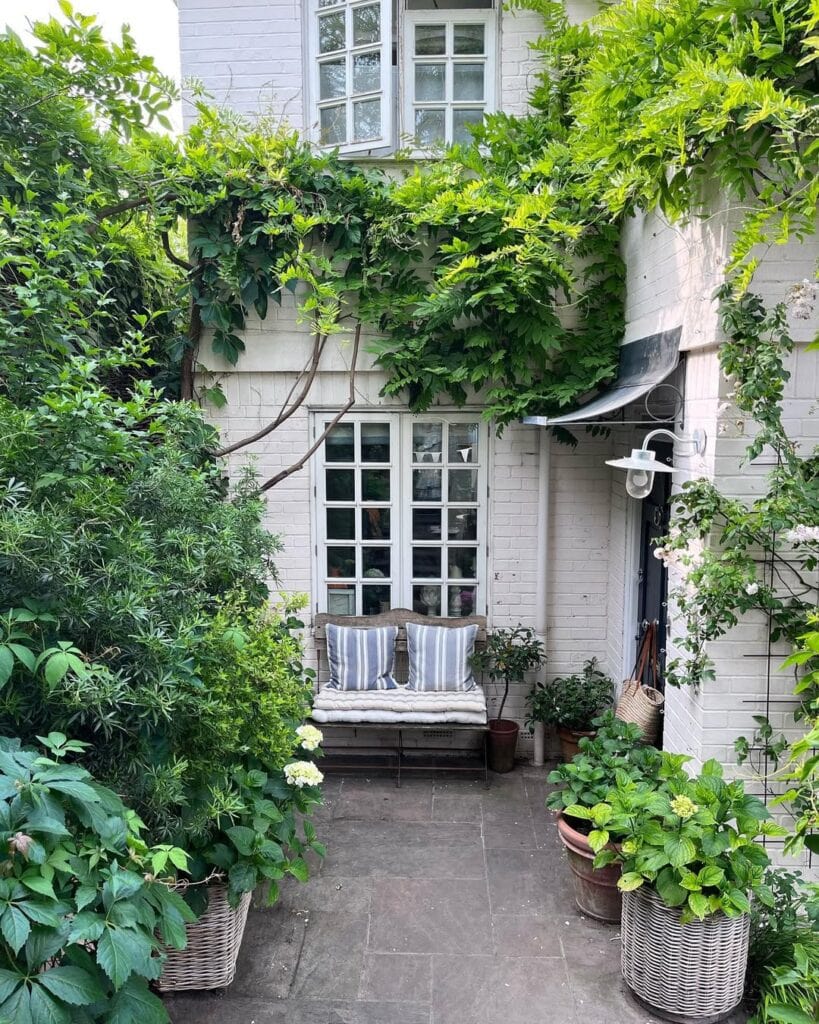
The Vertical Garden You Didn’t Have to Build
There’s almost no planting in this courtyard. Most of the greenery climbs up the house itself, with wisteria and jasmine vines trained across the upper-floor windows.
This approach works well when space is tight. When you can’t spare floor area, you can use the wall and roofline instead. A mature climber can cover more visual space in one season than a dozen potted shrubs could.
The ground level remains minimal, featuring just a single bench and a couple of pots, because the overhead canopy provides all the lushness the eye needs.
Takeaway: If floor space is limited, train one or two fast-growing climbers, such as jasmine, wisteria, or climbing hydrangea, up a wall or trellis. Vertical growth gives the impression of a lush garden without taking up any ground space.
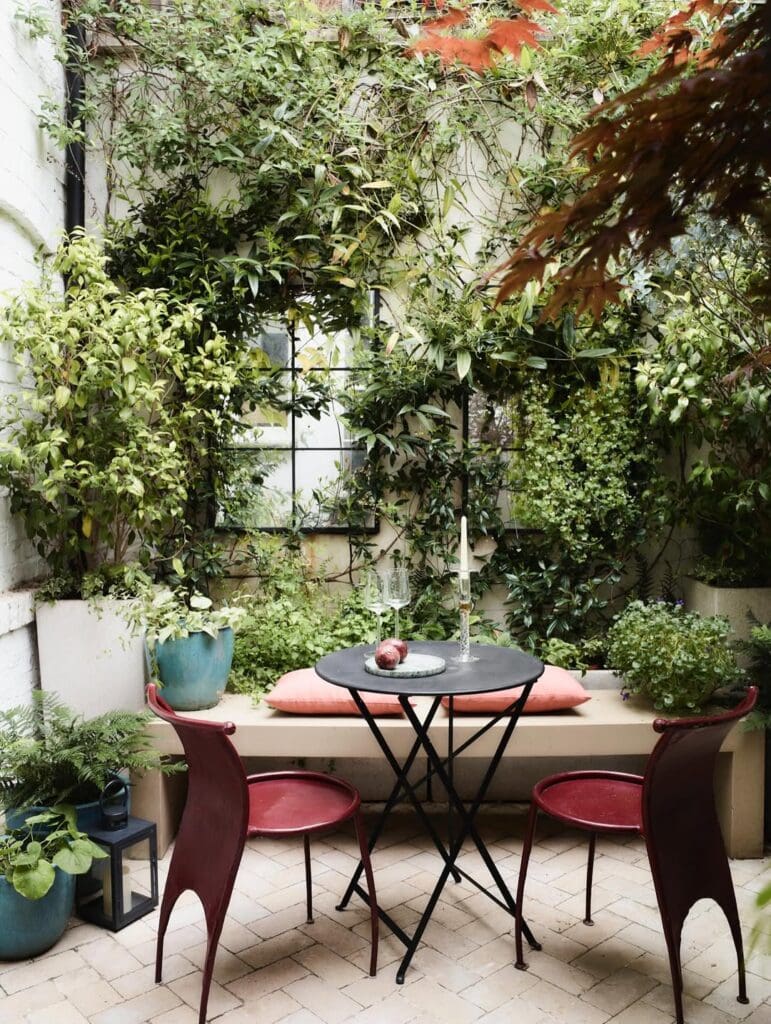
The Mirror That Doubles the Garden
Two black-framed mirrors are mounted directly on the wall and intentionally left to be overtaken by climbing plants, making them appear as “windows” into the garden rather than obvious tricks.
This approach works because a courtyard’s biggest enemy is the dead-end wall; your eye hits it and stops. A mirror breaks that reflects the plants back at themselves, visually doubling the depth of the space.
Placing a small bistro table and warm-toned chairs right in front of the mirrored wall strengthens the illusion, as the reflected greenery becomes the “view” the seating faces.
Takeaway: Hang an outdoor-rated mirror on your blankest wall and let climbing plants partially cover the frame. It instantly makes a boxed-in courtyard feel as if it extends beyond its actual boundaries.
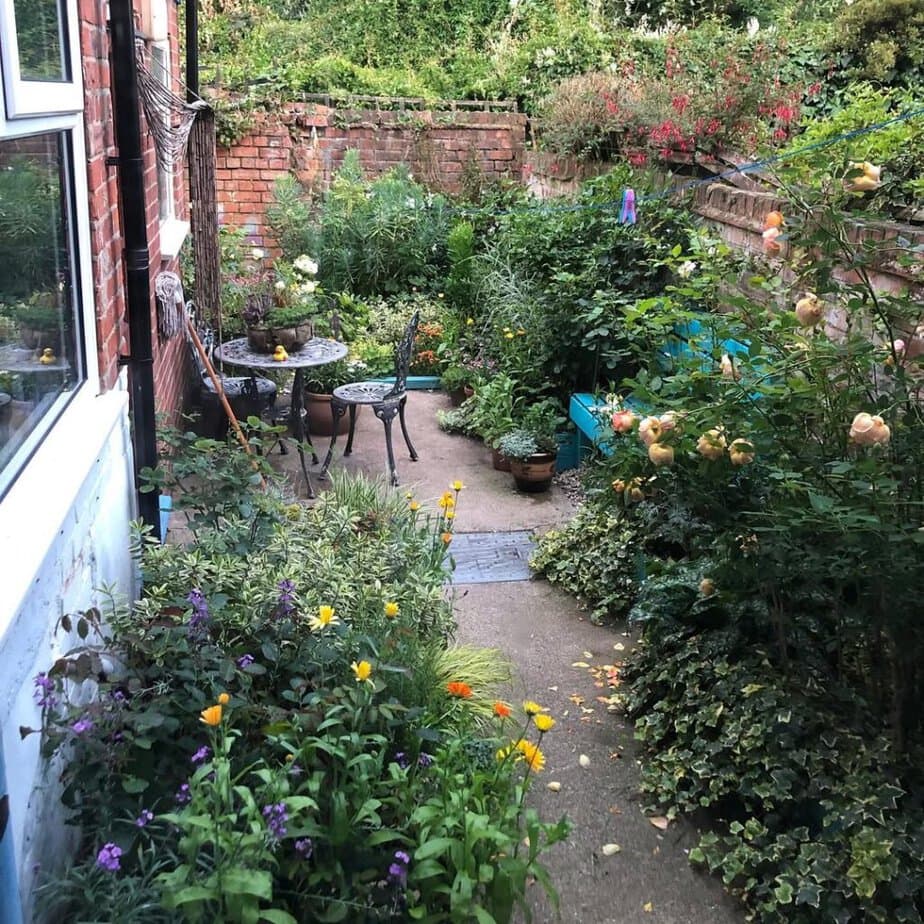
The Cottage Garden Squeezed Into a Side Passage
This shows that “small and narrow” doesn’t mean you have to go minimal.
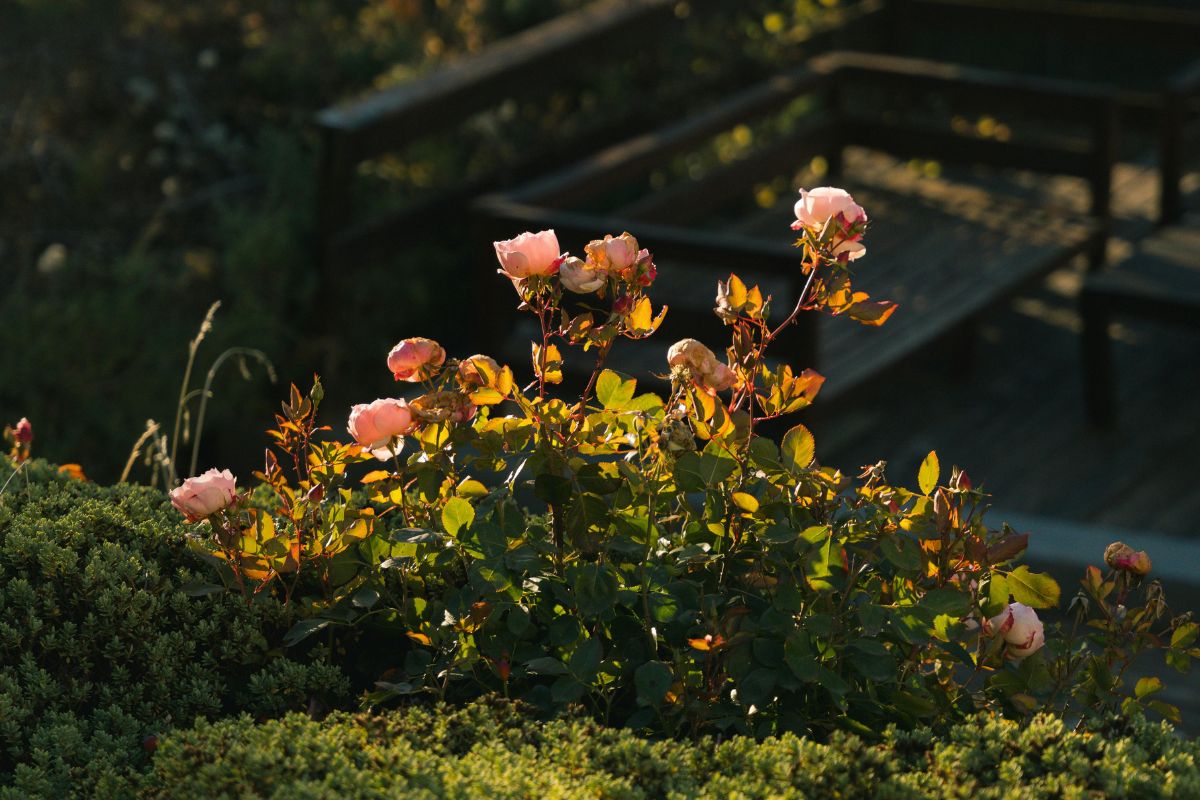
This courtyard is filled from edge to edge with roses, calendula, verbena, and ornamental grasses in a layered, slightly wild, cottage-style arrangement. There is just a narrow paved path and one small table in the middle. It works because the density itself is the design choice.
When every available inch is planted, the eye never sees bare hardscape or fencing. This makes the space feel abundant rather than cramped. The single café table and chair are placed off to the side instead of in the center.
This keeps the path clear and suggests, “sit here for a moment” rather than “this is the main feature.”
Takeaway: If you enjoy a fuller, cottage-style look, don’t hesitate to plant right up to the edges of a narrow space. Dense, layered planting hides a tight footprint much better than a few sparse specimen plants ever will.
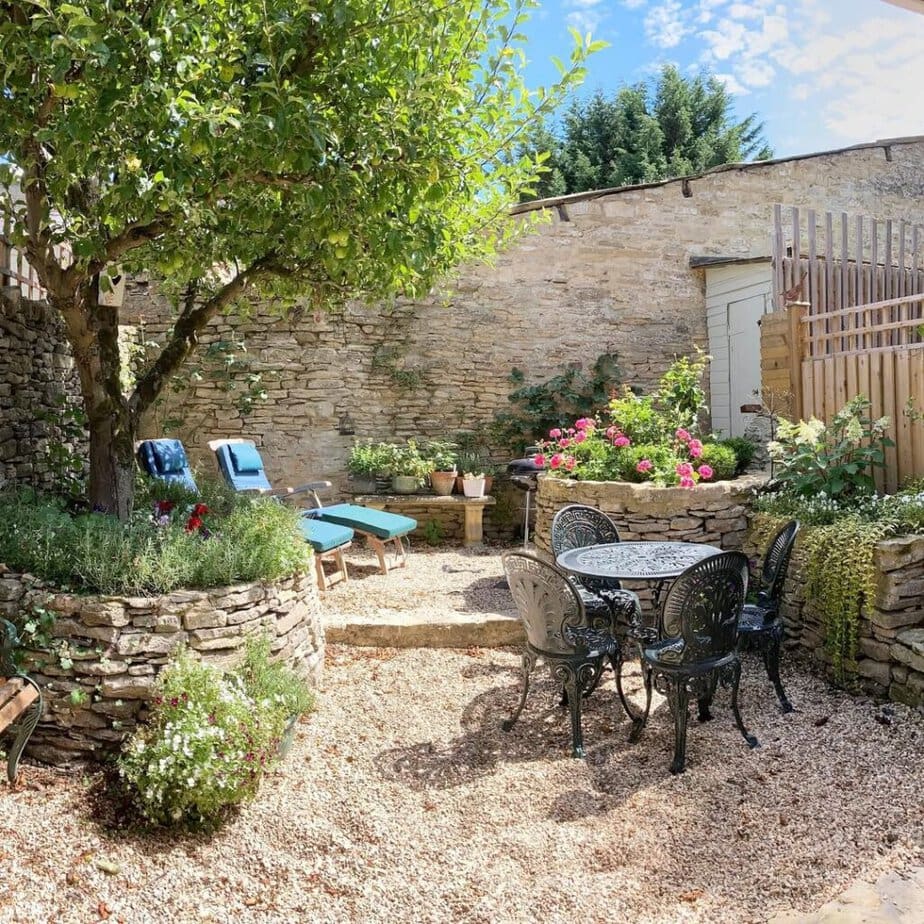
Raised Stone Beds That Turn Walls Into Furniture
This Cotswolds-style courtyard features dry-stone raised planters placed directly against the boundary walls.
This design raises the plants to waist height instead of keeping them at ground level. This elevation serves two purposes: it provides a built-in edge for perching or for resting drinks, and it brings flowers and trailing greenery into your line of sight rather than forcing you to look down at low borders.
Filling the open area with loose gravel, rather than paving or lawn, allows the hardscape to adjust to an oddly shaped boundary without needing to cut tiles or create awkward seams.
Takeaway: If your courtyard has uneven or aging walls, consider building raised stone or block planters against them. This way, the plants become the feature rather than trying to hide the walls.
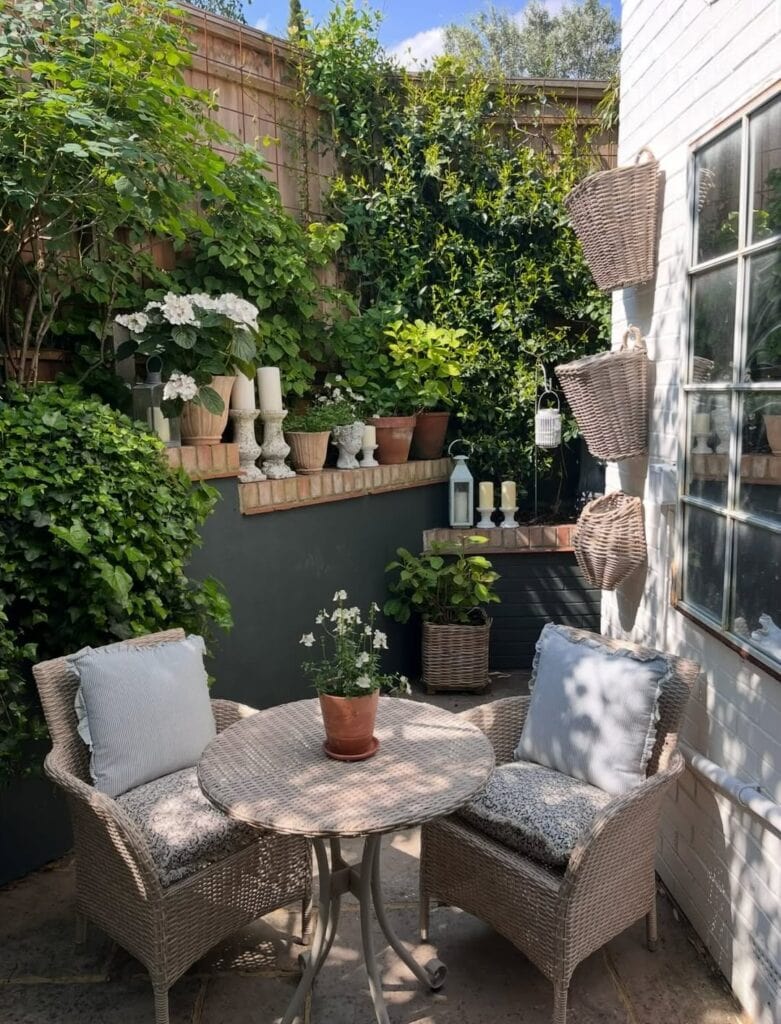
The Two-Chair Rule for Truly Tiny Footprints
This setup shows that a courtyard doesn’t need much space to feel complete; it needs restraint. Two compact wicker chairs and a small round table fit into a space barely wider than the chairs themselves.
The surrounding walls and fence are almost completely hidden by ivy, climbers, and a dense hedge. Hanging woven baskets on the house wall and placing candles and pots along the low brick ledge adds layered detail at eye level without taking up any floor space.
Takeaway: In a space too small for a full dining set, use two chairs and a small table. Then, focus on your decorative details by placing them upward on walls, ledges, and hanging baskets rather than on the ground.
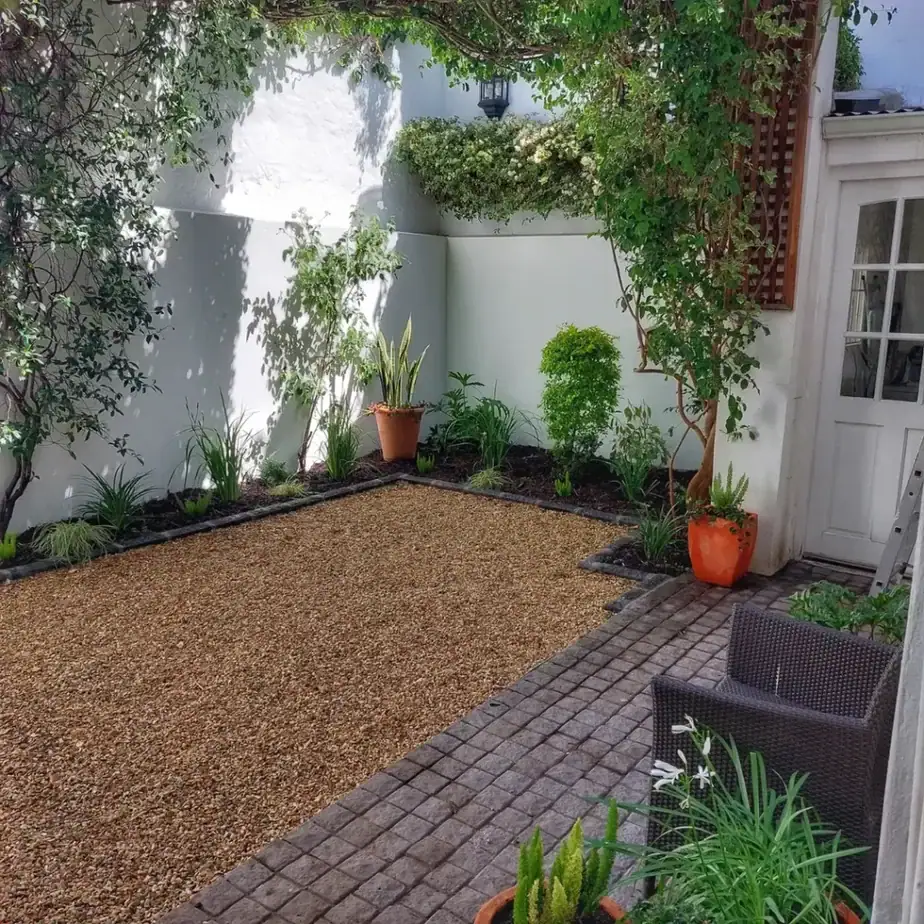
The Gravel Rectangle That Makes “Empty” Feel Deliberate
A clean rectangle of golden gravel sits at the center, with planting limited to narrow borders along two sides.
This shows that negative space is a design tool, not a missed chance. The black edging strip separates the gravel from the soil. That crisp line makes the open gravel area look intentional and finished, rather than an unplanted gap waiting to be filled.
Keeping the far wall mostly bare with white render and having just one trained climber overhead provides a calm resting point for the eye after the layered greenery around the doorway.
Takeaway: You don’t need to plant every surface. A clearly edged rectangle of gravel or pavement, even a small one, can be the main feature itself, especially if you’re short on time or budget for planting.
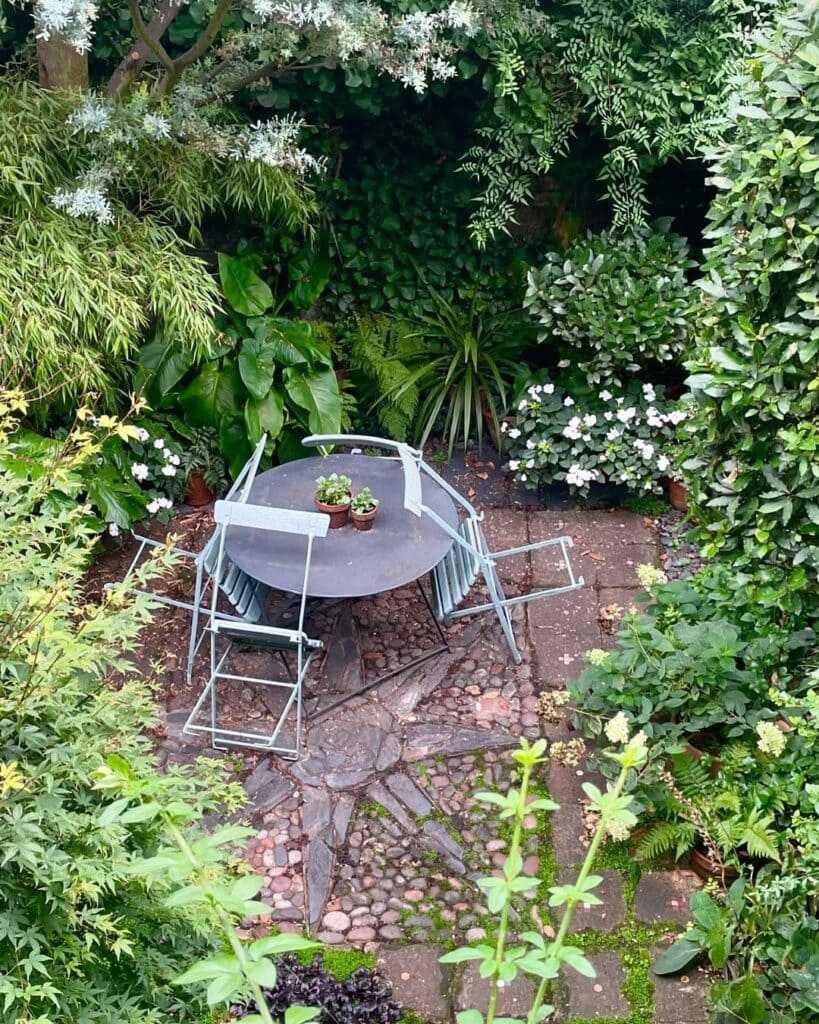
The Hidden Room Behind the Foliage
This courtyard is almost completely hidden by the surrounding plants. Bamboo, ferns, and impatiens grow so thickly around the seating area that you have to stand right on top of it to notice it.
The method here is to use height and density as walls. Instead of a fence or hedge marking the boundary, the plants wrap around the table like a small room. The floor is made of mosaic paving, arranged in a star pattern with reclaimed cobbles and stones, giving the area a clear, finished look.
Because the overhead canopy is just as full as the sides, the space feels enclosed and private rather than merely small.
Takeaway: If privacy is more important than visibility, let dense planting close in from above and the sides. Don’t try to keep the courtyard feeling “open.” A fully enclosed green nook often feels more like an escape than an open space.
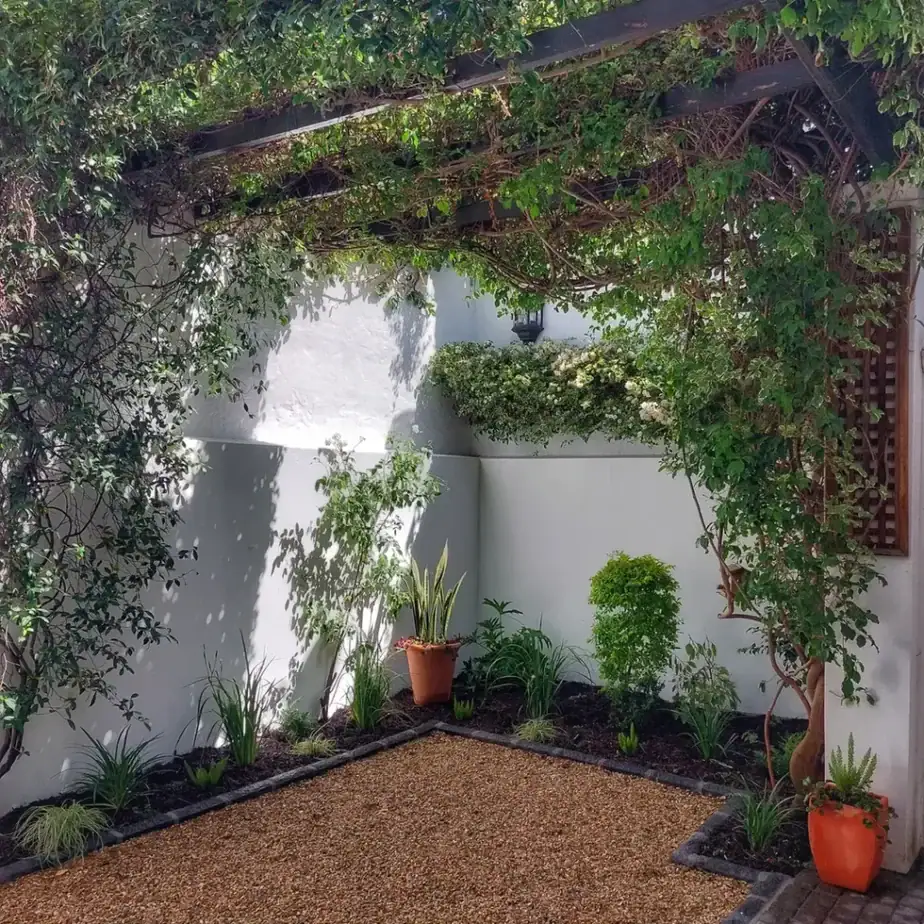
The Pergola That Borrows the Ceiling
A simple wooden pergola sits above, filled with climbing plants.It extends the garden into a space that most small courtyards overlook: the air above head height. Below, the ground treatment remains minimal, featuring gravel with a black-edged border and a few structural plants like snake plants and small shrubs along the wall.
The real visual interest occurs overhead in the dappled, moving shade. This layering, with the canopy above and a quiet floor below, turns the courtyard into a shaded garden room rather than just a gravel yard surrounded by walls.
Takeaway: Before adding more pots and planters at ground level, look up. A simple pergola or overhead trellis with one or two climbers can introduce an extra layer of greenery and shade without taking up floor space.
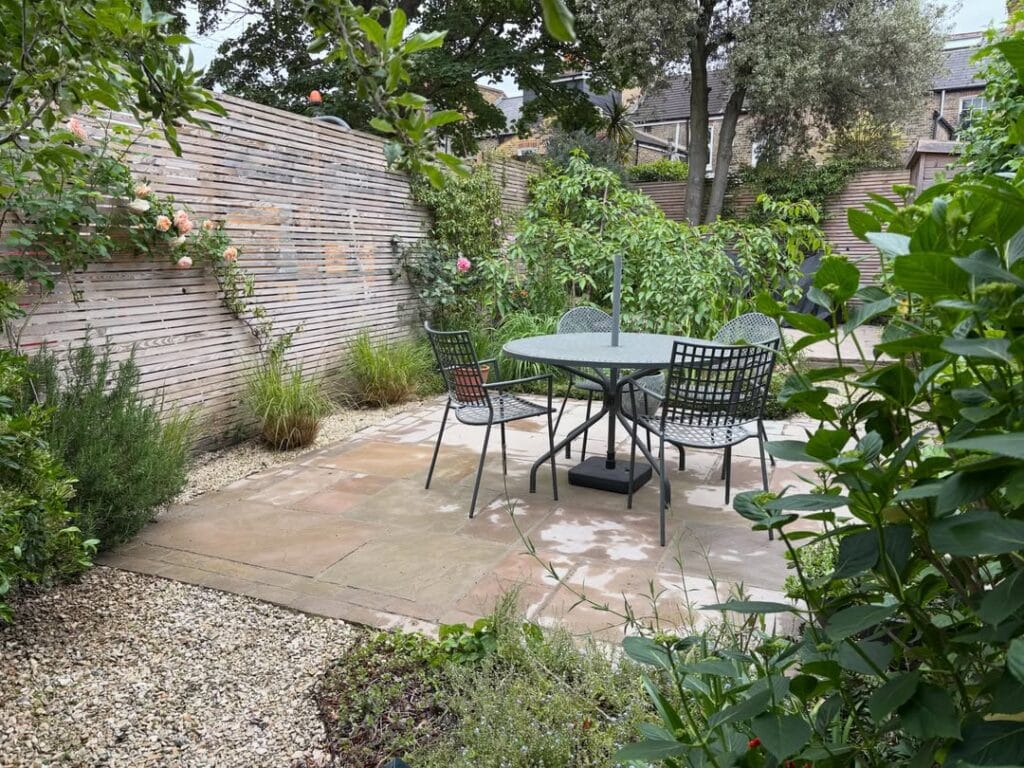
The Slatted Fence That Doubles as Décor
Instead of hiding the boundary fence, this courtyard uses horizontal slatted timber as a main visual feature. Climbing roses grow directly on it, creating blooms that sit against the warm wood like a living mural.
The play of light and shadow between the slats creates more visual interest than a solid fence could. It keeps the eye moving instead of resting on a flat, blank surface. Ornamental grasses and gravel at the base soften the transition from the fence to the paving without crowding the small dining set in the center.
Takeaway: If you plan to install or replace a boundary fence, choose a horizontal-slatted style rather than a solid panel. It adds texture on its own and provides climbing plants with something to grow on and display against.
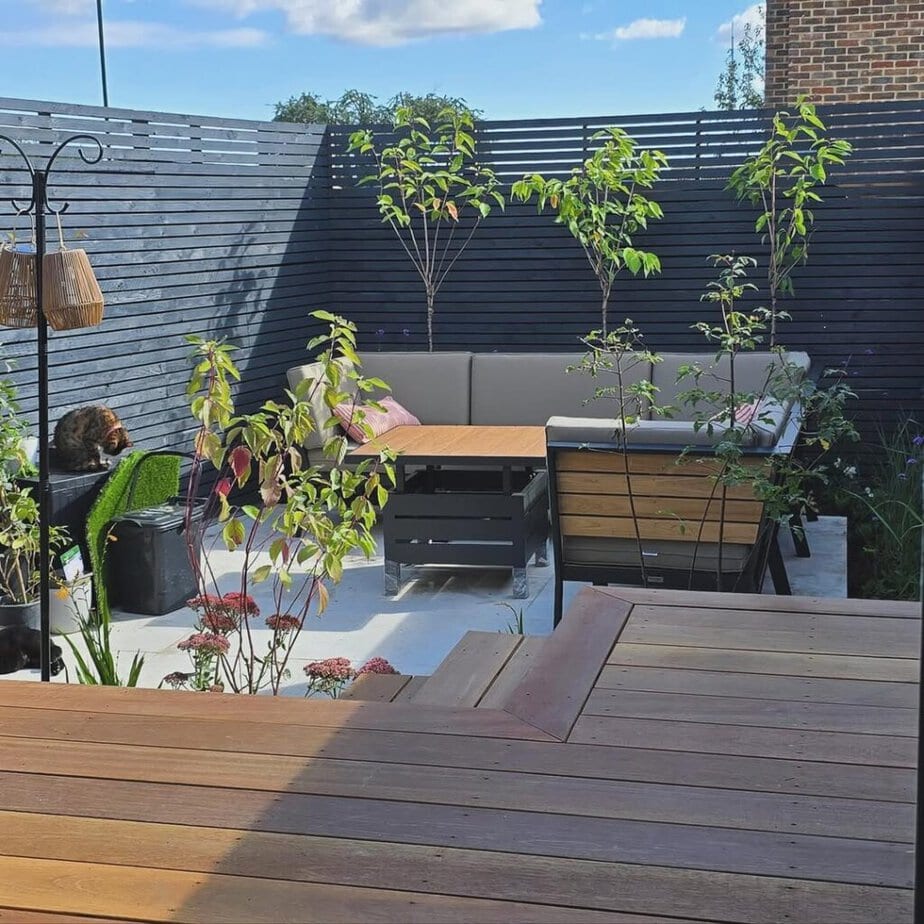
The Dark Backdrop That Makes Greenery Pop
This courtyard is painted a deep charcoal instead of leaving the privacy screening as natural timber or white. The effect is immediate: every leaf, blossom, and cushion in front of it appears brighter and more vivid.
Dark backgrounds also tend to recede visually, which is the opposite of what you might expect in a small space. Instead of the boundary feeling like it closes in, it seems to fade away, allowing the plants and furniture to become the main focus.
Adding a few slender ornamental trees right against the screen provides height without adding bulk because their canopies remain narrow and let light reach the seating below.
Takeaway: Painting a fence or screen dark charcoal or black, instead of leaving it pale, can make a small courtyard feel larger by visually pushing the boundary backward while enhancing the colors of your plants.
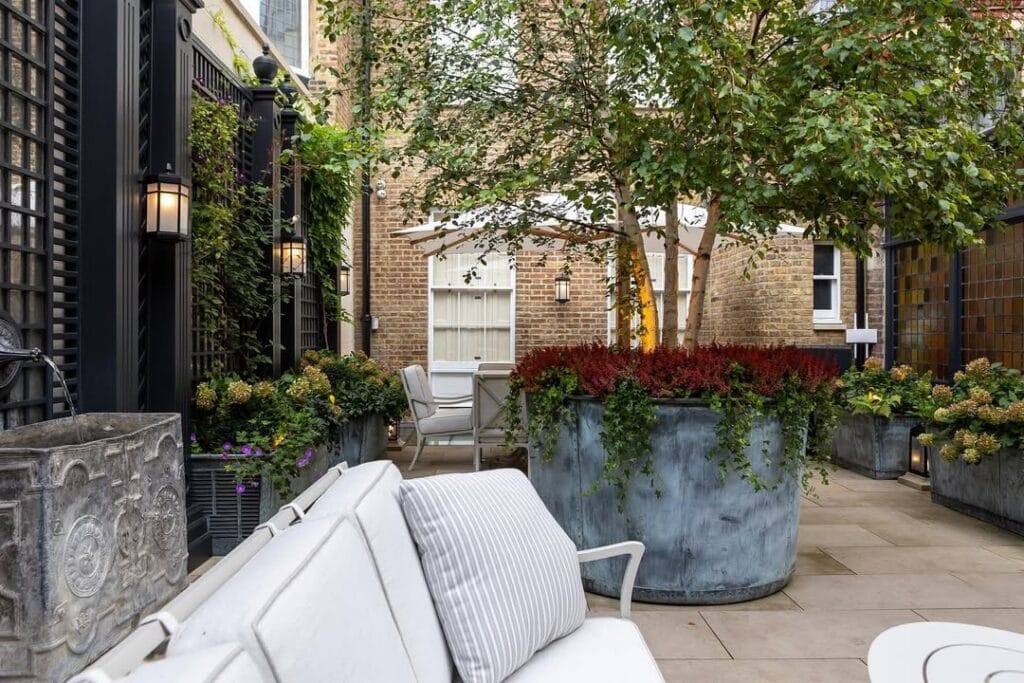
The Oversized Planter as Architecture
In this design, weathered zinc planters that can hold small multi-stem birch trees serve as architectural columns. They divide a long, narrow courtyard into separate areas without needing walls or partitions.
The key is scale. The large planters appear to be a permanent feature, making the space feel like an established garden rather than a temporary patio.
Wall-mounted lanterns on either side of the trellis provide warm pools of light at different heights. This lighting prevents the narrow space from feeling like a flat corridor at night.
Takeaway: In a long, narrow courtyard, use a few oversized planters as informal “walls” to separate the space into zones. Larger pots with substantial plants create a sense of structure, not just decoration.
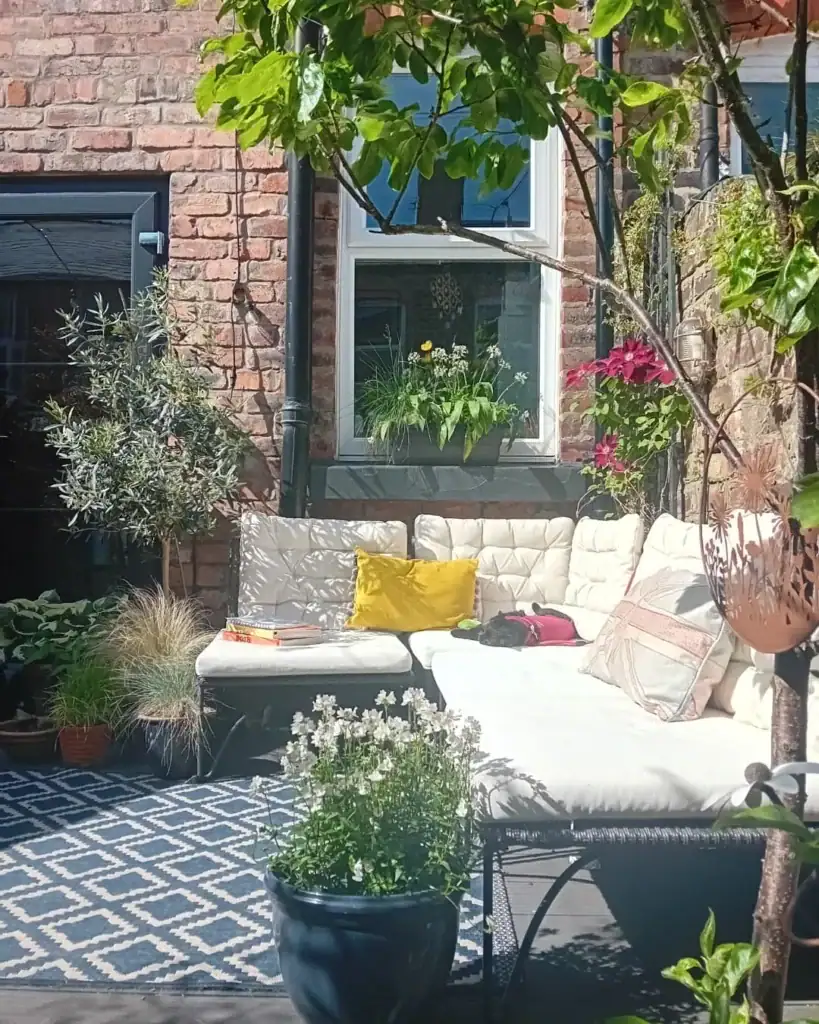
The Rug That Brings the Indoors Out
This sun-drenched nook features an outdoor rug under the seating area. This change makes the brick and decking feel like a furnished room instead of just a leftover patch of yard.
Adding mismatched cushions in mustard, white, and patterned fabric creates the kind of layering you’d expect on an indoor sofa. This layering helps reinforce the “room” feeling.
A potted olive tree and clematis climbing a metal trellis soften the hard brick wall behind. Because every surface rug, cushion, and plant enhances the visual appeal, the space feels larger than it actually is.
Takeaway: Use an outdoor rug under your seating area, even on a tiny patio or balcony. It’s one of the quickest ways to transform a paved courtyard corner into a real room instead of an afterthought.
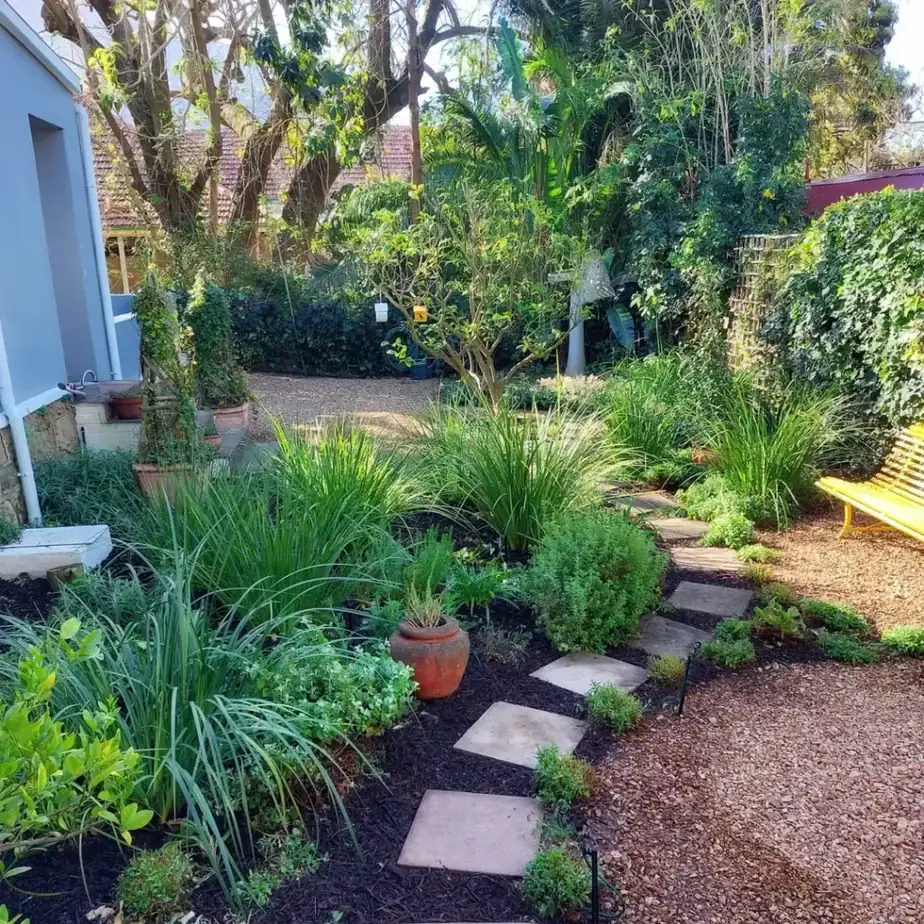
The Stepping-Stone Path That Makes Small Feel Like a Journey
Rather than using one continuous paved surface, this garden features individual stone pavers set in dark mulch and gravel.
This design creates a winding path through lush grassy plants, even though the actual distance is short. This technique works because a curved path with distinct steps feels longer and more thoughtful than a straight concrete slab.
It transforms a quick walk into a small “journey” through the space. Adding ornamental grasses of varying heights along the edge of the path helps it feel enclosed and more like a garden than a plain walkway.
Takeaway: Replace a straight paved path with individual stepping stones placed in gravel or mulch, even over a short distance. The visual rhythm of separate steps makes a compact garden feel more spacious and inviting than it really is.
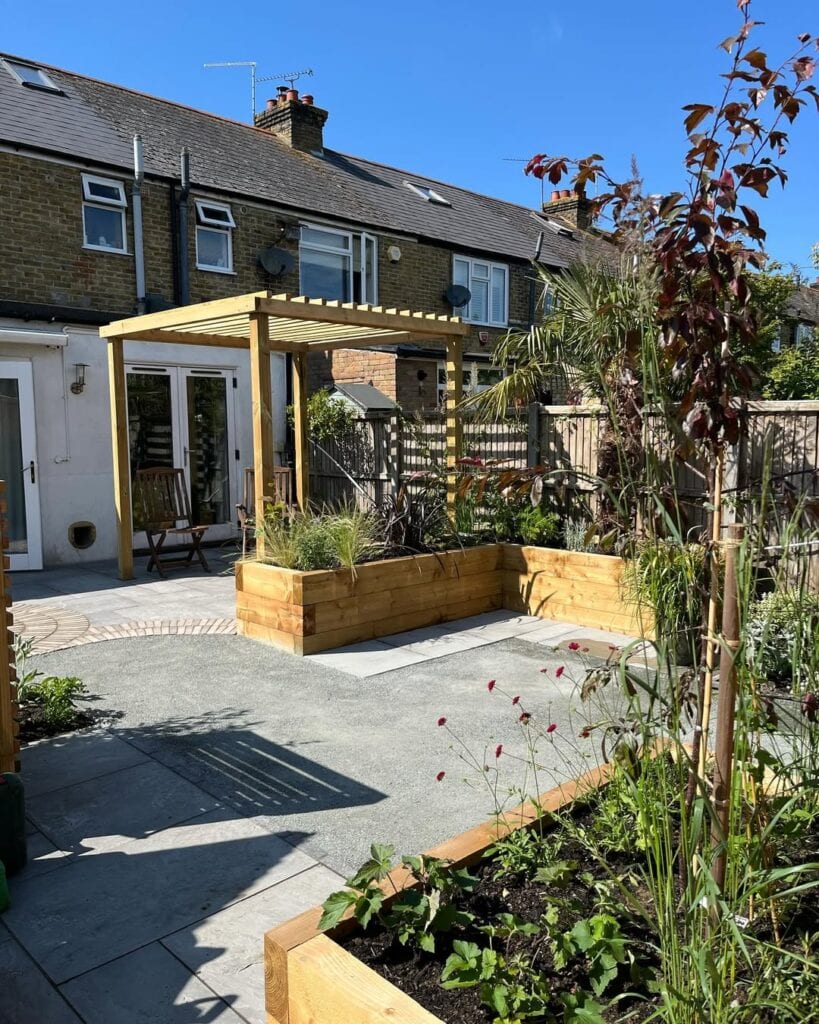
The Pergola-and-Planter Combo That Defines a “Room” Without Walls
Here, a freestanding timber pergola is paired with built-in raised planters to create a clear seating area in an otherwise open gravel yard.
No fence or partition is needed. This approach is architectural. The pergola’s four posts and overhead slats define the “ceiling” and corners of an outdoor room. Meanwhile, the planters on the ground act as low walls, helping your eye recognize a distinct space within the larger garden.
Using pale gravel for the open area and warm brick paving under the pergola creates a subtle change in materials. This further emphasizes the separation without any physical dividers.
Takeaway: To create a “room” in an open courtyard without sacrificing space for fences, combine a simple overhead pergola with raised planters at its base. The structure itself defines the zone.
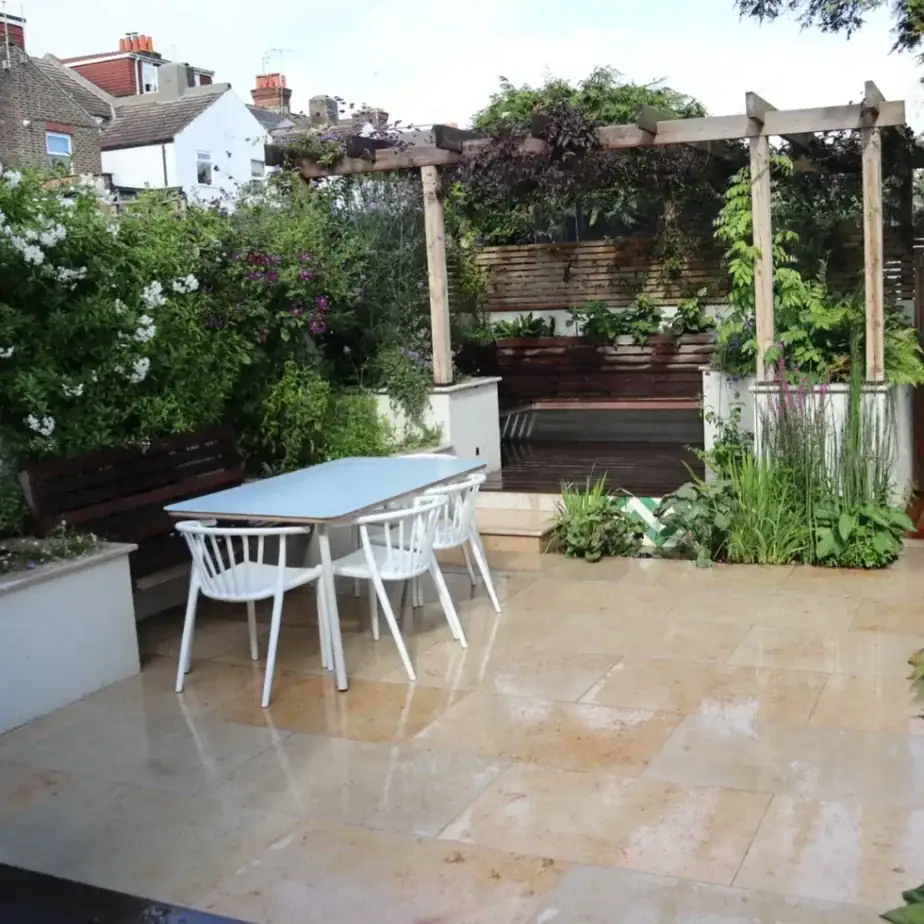
The Sunken Lounge That Steals Square Footage From Nowhere
This courtyard features a slightly recessed bench seating area under a pergola at the back. A step down in level visually and physically separates the “lounge” from the “dining” area, even though the entire space is paved with the same warm stone.
The change in elevation achieves the zoning effect that a wall typically provides. Meanwhile, the continuous flooring keeps the overall space feeling unified instead of fragmented.
Dense plants, including jasmine, verbena, and ferns, cover both side boundaries. As a result, the only “walls” visible are green ones.
Takeaway: If you’re renovating a courtyard and can adjust the levels, even a single step down for a lounge or seating nook can create the impression of a separate room without adding any partitions.
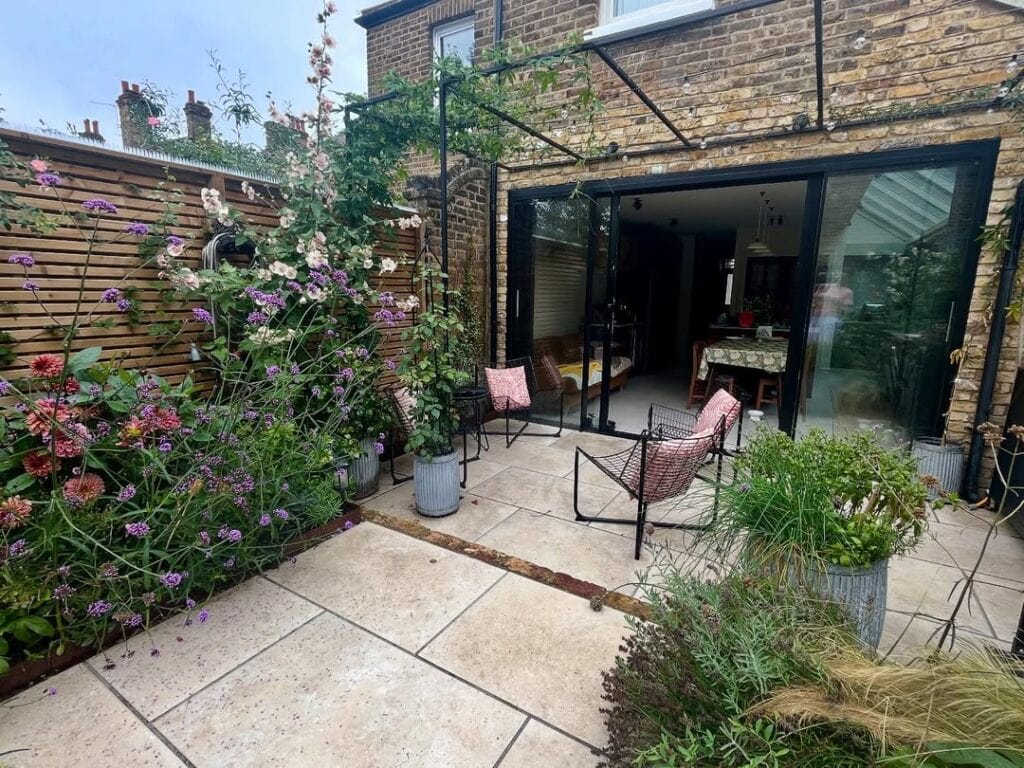
The Mid-Century Palette in a Brick-and-Timber Frame
This courtyard combines warm reclaimed brick and horizontal timber slatting with mid-century furniture, like wire-frame chairs in dusty pink and a galvanized planter that also serves as a side table.
This design shows that a small space can express a strong style without resorting to generic outdoor furniture.
The horizontal lines of the slatted fence, paving joints, and overhead pergola guide the eye smoothly through the area. This creates a curated feel with the various textures and one standout piece, avoiding any sense of clutter.
Tall, loose flowers such as hollyhocks and verbena flowing in from one side soften the straight lines without distracting from the furniture’s clean shape.
Takeaway: Avoid sticking to “safe” outdoor furniture in a small courtyard. A few unique pieces in unexpected colors or shapes can give a small space real personality, especially when there’s less to compete for attention.
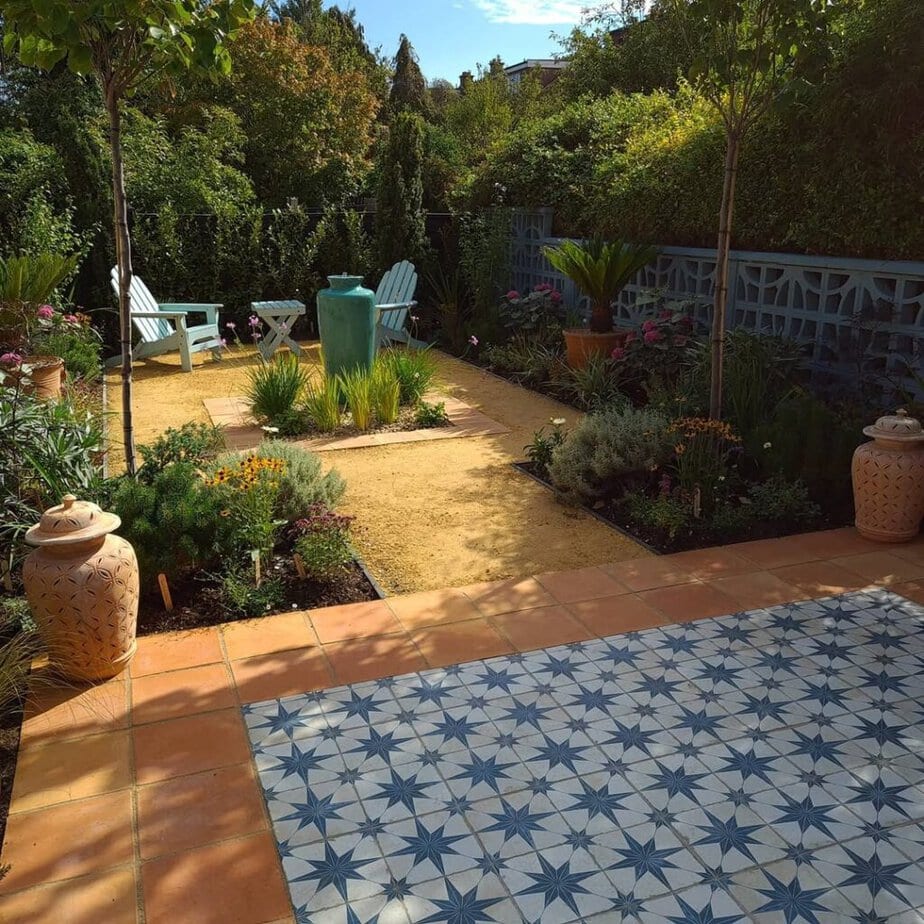
The Patterned Tile That Acts as a Threshold
Right where the house meets the garden, this courtyard features a bold star-patterned tile as a sort of “welcome mat” before stepping down into simpler terracotta and gravel.
This creates a clear visual cue that indicates “this is the good seating spot” before you even take in the rest of the layout. Using the same blue tone in the perforated breeze-block-style fencing further along connects the patterned threshold to the boundary treatment.
This way, the color feels intentional instead of just a random accent. Beyond the tiled area, a simple gravel circle with a glazed teal jar as a focal point and two Adirondack chairs keeps the rest of the layout calm. This means the patterned tile doesn’t compete with anything too busy.
Takeaway: If you can only afford one standout material, invest it in the threshold tile or paving right outside your door. A patterned “entry” zone makes even a simple courtyard feel more thoughtful instead of unfinished.